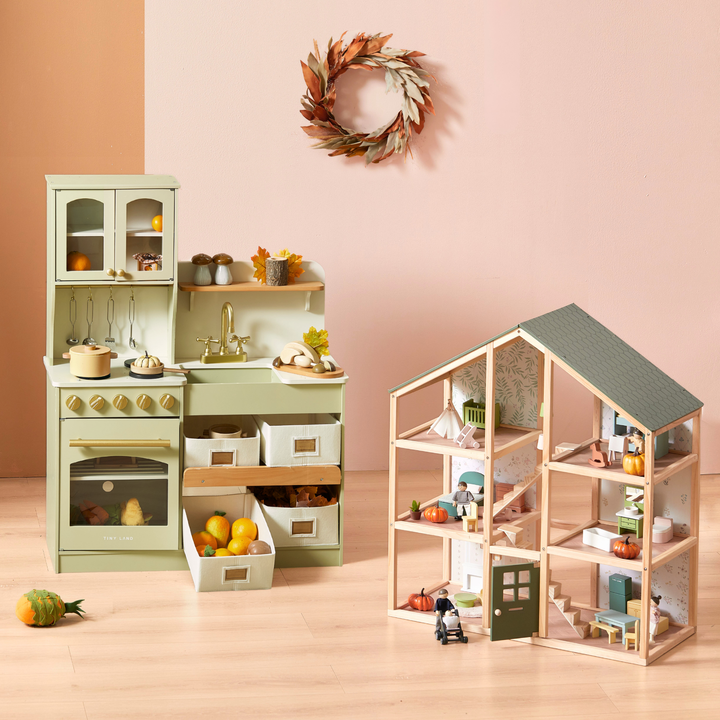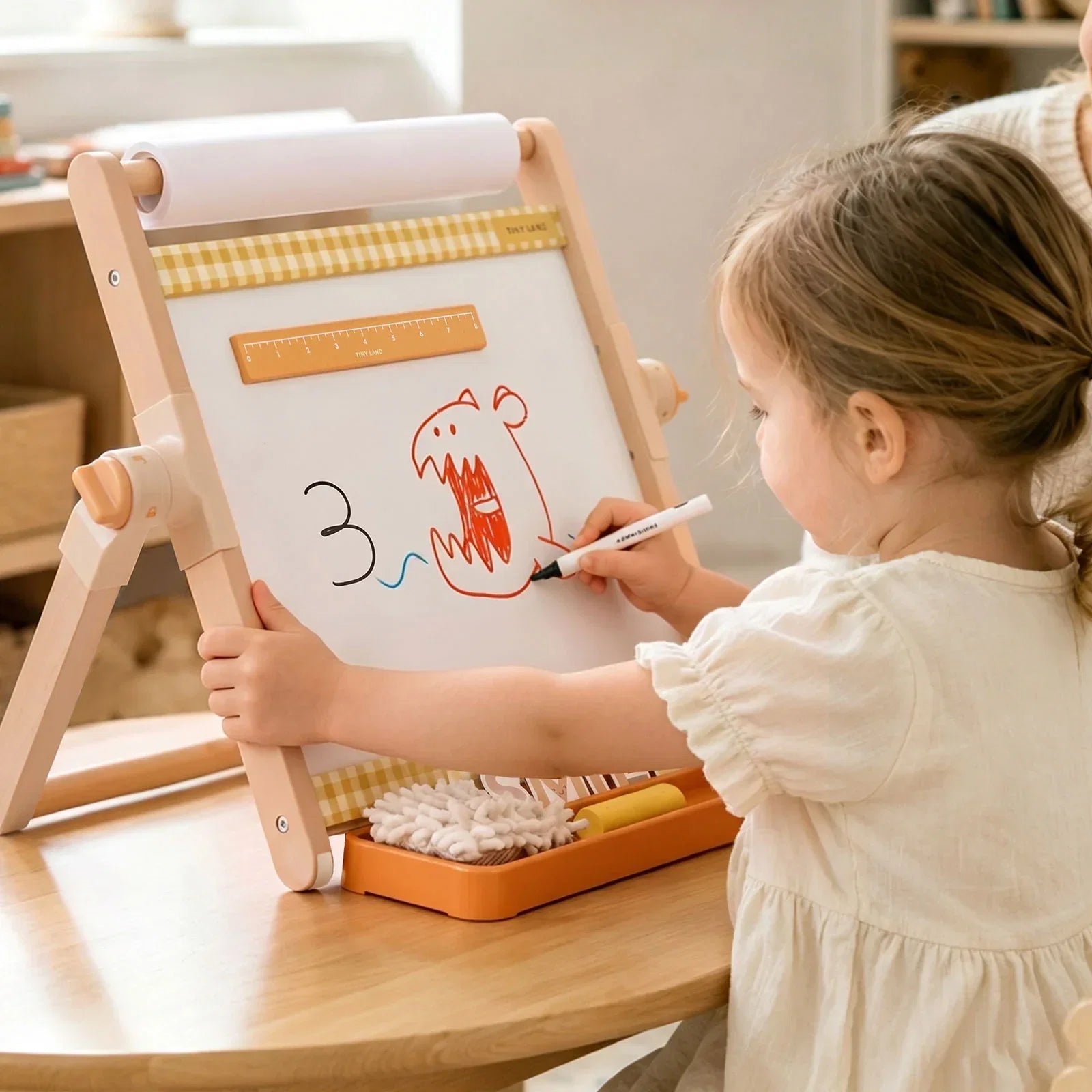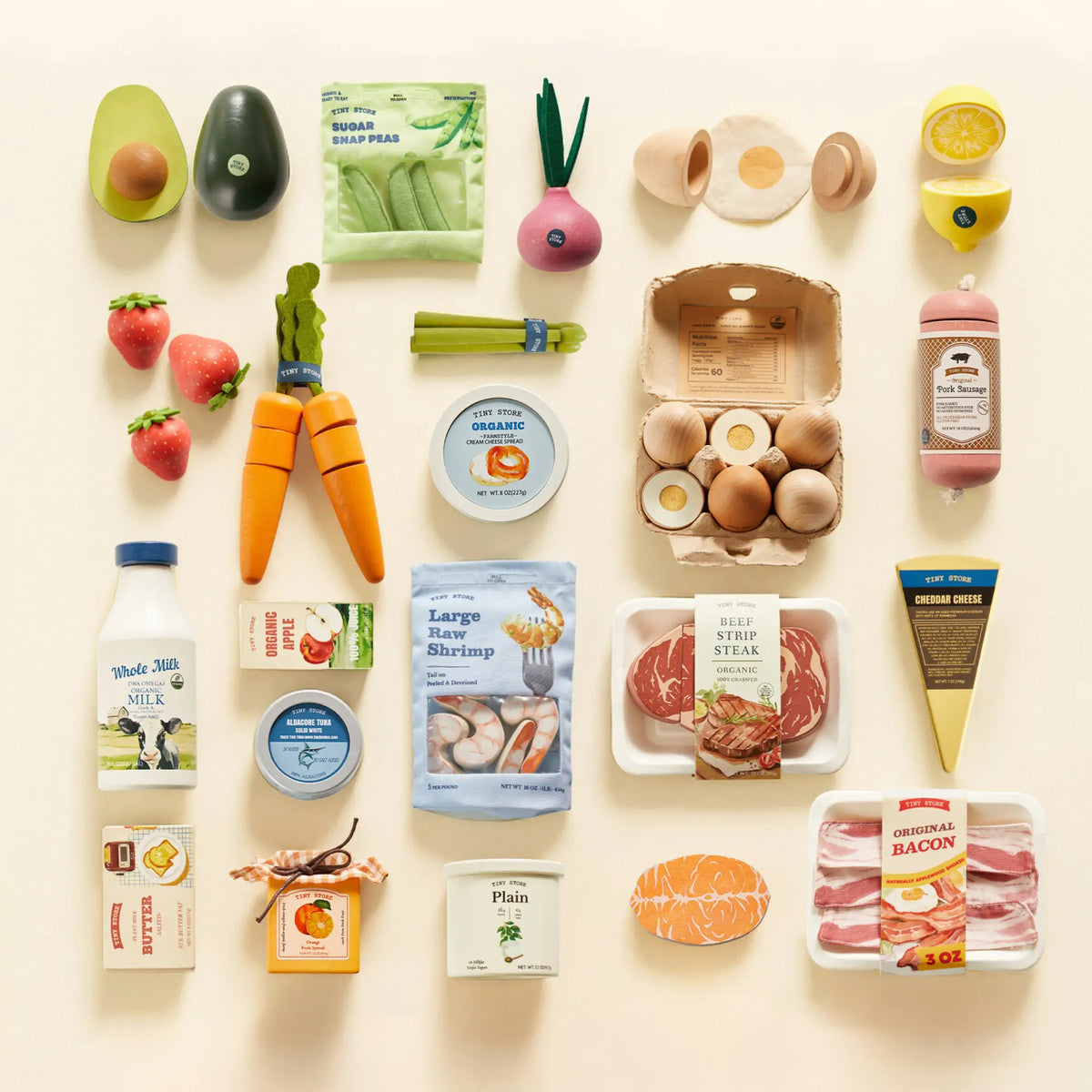
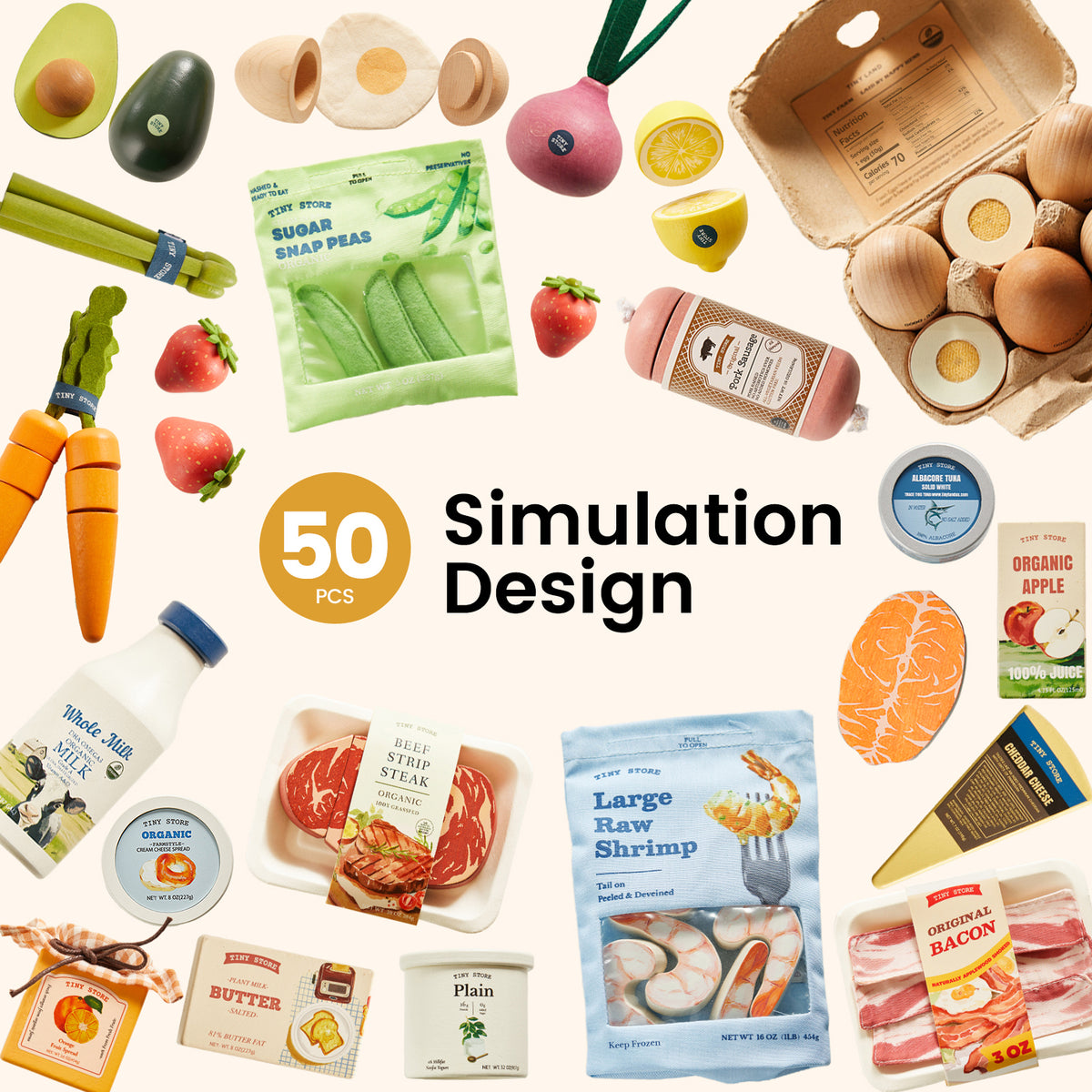



If your child already has a play kitchen, you may be wondering: Do kids really need a toy fridge, too?
The answer is: not every child needs one. But for children who enjoy pretend cooking, grocery shopping, organizing play food, or recreating everyday routines, a toy refrigerator can add another layer to play.
A play fridge gives children a place to store pretend food, make choices about what they need, and incorporate familiar household routines into their own stories.
If you're considering a toy fridge for your child, here's what to know about how children use them, what age they may be appropriate for, how wooden and plastic toy refrigerators compare, and what to look for before buying one.

What Is a Toy Fridge Used For?
A toy fridge, also called a toy refrigerator or play refrigerator, is a pretend-play appliance designed to recreate some of the familiar routines associated with a real refrigerator.
Depending on the design, children may use a toy fridge to:
-
Store pretend food
-
Organize groceries
-
Pretend to prepare meals
-
Play grocery store
-
Play restaurant
-
Recreate family mealtimes
-
Feed dolls or stuffed animals
-
Create their own cooking stories
-
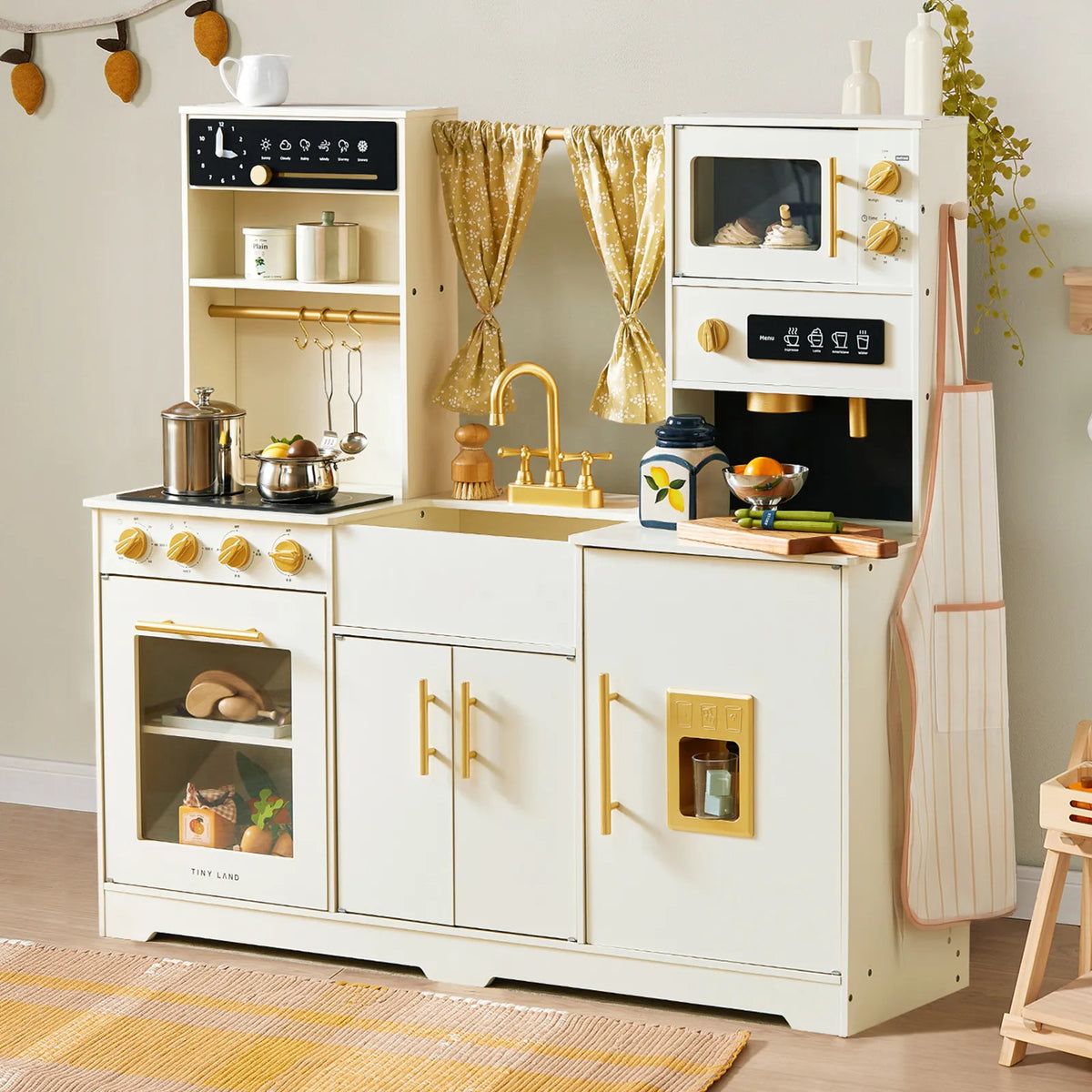
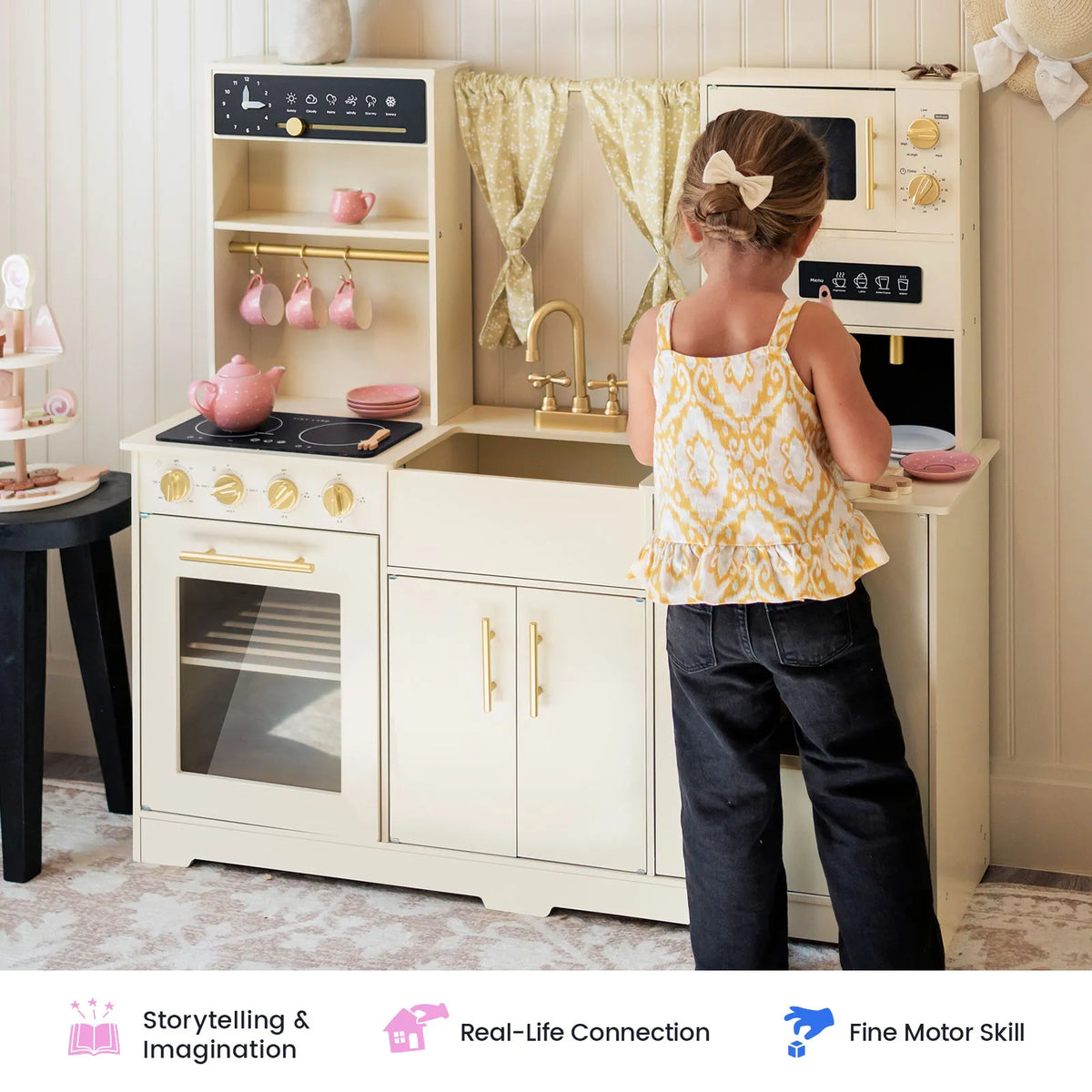
Combine refrigerator play with a play kitchen
The important part is that there isn't one correct way to play with a toy refrigerator.
A child might use it as a refrigerator in the morning, a grocery-store display in the afternoon, and part of a pretend restaurant later.
That's one of the strengths of open-ended pretend play: the child gets to decide what the toy becomes.

Do Kids Actually Need a Toy Refrigerator?
Kids don't need a toy refrigerator in the way they need everyday household essentials.
Instead, ask:
Would a toy fridge add something new to the way my child already likes to play?
If your child enjoys a play kitchen, a refrigerator can expand pretend play beyond cooking.
Instead of simply pretending to make a meal, children can act out a longer everyday routine:
Shop for groceries → bring them home → put food away → prepare a meal → serve it
That sequence gives children more opportunities to make choices, create stories, and involve other people in their play.
For a child who already enjoys pretend play, a toy refrigerator can therefore be less about adding "another toy" and more about creating another part of their pretend world.

Why Add a Toy Refrigerator to a Play Kitchen?
A play kitchen provides a natural setting for pretend cooking. A refrigerator can extend that setting by adding what happens before and around cooking.
Think about a real kitchen.
Before preparing a meal, someone might:
-
Decide what to make
-
Check which ingredients are available
-
Take food out of the refrigerator
-
Organize groceries
-
Prepare ingredients
A toy fridge gives children a way to recreate some of those familiar routines during pretend play.
For example: "We're making breakfast. We need milk and eggs."
Your child can open the refrigerator, find the pretend ingredients, bring them to the play kitchen, and continue the story.
The refrigerator becomes part of a larger pretend-play environment, rather than a standalone toy.

What Can Kids Do With a Toy Fridge?
A toy refrigerator can support many different pretend-play scenarios.
Pretend Grocery Shopping
Give your child a small basket and several pieces of pretend food.
Ask:
"What should we buy today?"
After "shopping," your child can bring the groceries home and decide where everything belongs.
Organize Pretend Food
A refrigerator naturally creates opportunities to organize play food.
Children can decide where different foods belong and create their own system for their pretend kitchen.
There doesn't need to be one correct answer. The goal is to let children make choices within their play.
Prepare a Pretend Meal
The refrigerator can become the first step in a cooking story.
Your child can:
-
Decide what to make.
-
Find the ingredients.
-
Take them from the refrigerator.
-
Bring them to the play kitchen.
-
Prepare the pretend meal.
-
Serve it to someone else.
Play Restaurant
A toy fridge can become part of a pretend café or restaurant.
Children can pretend to check ingredients, prepare orders, organize food, and serve customers.
With siblings or parents involved, everyone can take on a different role.
Play Family
Children often recreate familiar routines they see at home.
A toy refrigerator can become part of pretend breakfasts, lunches, dinners, snack time, or family gatherings.
The child decides who is eating, what they're serving, and what happens next.

What Age Is a Toy Fridge Good For?
The appropriate age depends on the specific product and the individual child.
Always check the manufacturer's recommended age range and safety guidance before buying a toy refrigerator.
It's also useful to consider whether your child is interested in pretend play and everyday routines, rather than choosing a toy based only on age.
Toddlers
Younger children may begin with simple actions such as:
-
Opening and closing a door
-
Taking pretend food out
-
Putting objects away
-
Moving food around
-
Copying familiar household routines
At this stage, simple and intuitive play can be more useful than having lots of features.
Preschoolers
Preschoolers may create more complete pretend-play scenarios.
A toy refrigerator can become part of:
-
Grocery-store play
-
Restaurant play
-
Family role-play
-
Cooking stories
-
Food organization
-
Hosting pretend guests
Children can also combine a refrigerator with play food, dolls, stuffed animals, and a play kitchen.
Older Preschoolers and Young Children
Older children may create more elaborate scenarios.
They might run a pretend restaurant, create menus, assign roles to siblings, organize ingredients, or invent stories around a family meal.
The takeaway is simple:
The best age for a toy refrigerator isn't just a number. It's the combination of the product's recommended age and your child's interest in pretend play.
 Are Toy Fridges Good for Toddlers?
They can be, if the specific toy is designed for the child's age and abilities.
Parents should check the manufacturer's age recommendation, safety information, size, moving parts, and any included accessories.
For younger children, simple pretend-play features may be easier to use than complicated interactive functions.
If you're shopping for a toddler, don't choose a toy simply because it looks realistic. Consider whether your child can comfortably and safely interact with it.

Wooden vs. Plastic Toy Fridges: Which Is Better?
Once you've decided that a toy refrigerator could be a good fit, you may have another question:
Should you choose a wooden or plastic toy fridge?
There isn't one material that is automatically best for every family.
The right choice depends on your child's play style, your available space, the product's construction, and the features that matter most to you.
Wooden Toy Fridges
Wooden toy refrigerators often have a more furniture-like appearance and can fit naturally into playrooms alongside wooden play kitchens, market stands, dollhouses, and other pretend-play toys.
A wooden model may be a good fit if you value:
-
A substantial, furniture-like design
-
A cohesive playroom aesthetic
-
Open-ended pretend play
-
A long-term pretend-play setup
-
Coordination with other wooden toys
One consideration is weight. Wooden play furniture is often less convenient to move frequently than lightweight plastic alternatives.
Plastic Toy Fridges
Plastic toy refrigerators are often lightweight and easy to move.
Depending on the individual product, some may also include interactive features such as sounds, lights, or other components.
A plastic model may be a good fit if you prioritize:
-
Lightweight construction
-
Easy movement
-
Easy-to-wipe surfaces
-
Interactive features
-
Bright or colorful designs
Plastic isn't automatically a lesser choice, just as wood isn't automatically a better one.
The quality and design of the individual product matter more than the material label alone.
 Wooden vs. Plastic Toy Refrigerator: Quick Comparison
| Feature | Wooden Toy Refrigerator | Plastic Toy Refrigerator |
|---|---|---|
| Overall feel | Often more substantial | Usually lightweight |
| Appearance | Often furniture-like | Often colorful or feature-focused |
| Portability | Less convenient to move | Generally easier to move |
| Play style | Often simple and open-ended | May include more interactive features |
| Playroom aesthetic | Often blends with furniture | Often looks distinctly toy-like |
| Cleaning | Follow the manufacturer's care instructions | Often easy to wipe |
| Good fit for | Dedicated pretend-play spaces | Families prioritizing portability or features |
Which Should You Choose?
Rather than asking "Is wood better than plastic?", ask: "Which type fits our family better?"
Choose a wooden toy fridge if:
-
You want a more furniture-like playroom.
-
Your child enjoys open-ended pretend play.
-
The refrigerator will stay in one main play space.
-
You want it to coordinate with other wooden play toys.
-
You value a substantial, built-in feel.
Choose a plastic toy fridge if:
-
You frequently move toys around.
-
Lightweight construction is important.
-
Easy wipe-down surfaces are a priority.
-
Your child enjoys interactive features.
-
You prefer a more colorful toy aesthetic.
The material is only one part of the decision.

What Should Parents Look for in a Toy Refrigerator?
Before buying a toy fridge, consider more than its appearance.
1. Age Recommendation
Start with the manufacturer's recommended age range.
If the refrigerator comes with accessories or moving components, make sure they are appropriate for your child's age.
2. Stability and Construction
A toy refrigerator is a piece of children's play furniture.
Look at its overall construction, stability, doors, handles, shelves, edges, and other components.
3. Size
Measure your available play space before buying.
A full-height toy refrigerator can become a central part of a pretend kitchen, but it also requires more floor space.
4. Storage
Storage is one of the most useful features of a play refrigerator.
Consider whether it has enough room for the pretend food and accessories your child already owns.
A well-designed storage area can also become part of the play itself.
5. Realistic Details
Some children enjoy toys that resemble objects they see at home.
Details such as doors, shelves, handles, storage compartments, or designated areas for pretend food can make the play environment feel familiar.
However, realistic design should still be easy for children to use.
6. Open-Ended Play Potential
Ask: "Can my child use this toy in more than one way?"
A refrigerator that works for grocery-store play, restaurant play, family role-play, and cooking stories can offer more possibilities than a toy designed around a single scripted activity.
7. Safety and Materials
Check the manufacturer's safety information, age recommendation, materials, construction, and care instructions.
Remember that the material alone doesn't determine whether a toy is safe.
Product design, manufacturing quality, age appropriateness, and applicable safety requirements all matter.

A Real-World Example: What to Look for in a Wooden Play Fridge
If you're considering a wooden play refrigerator, it can be helpful to look at the features that make a product useful within a larger pretend-play setup.
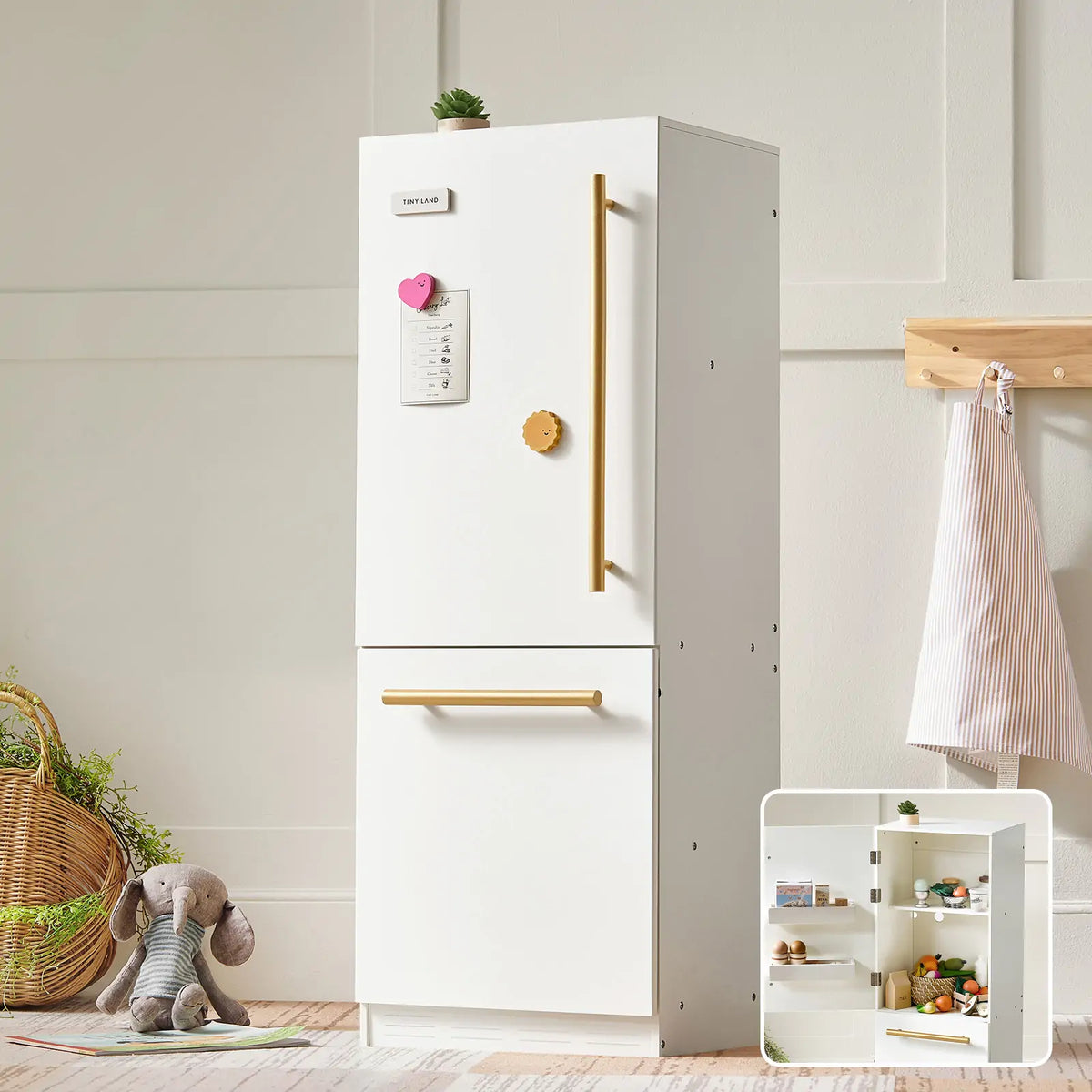
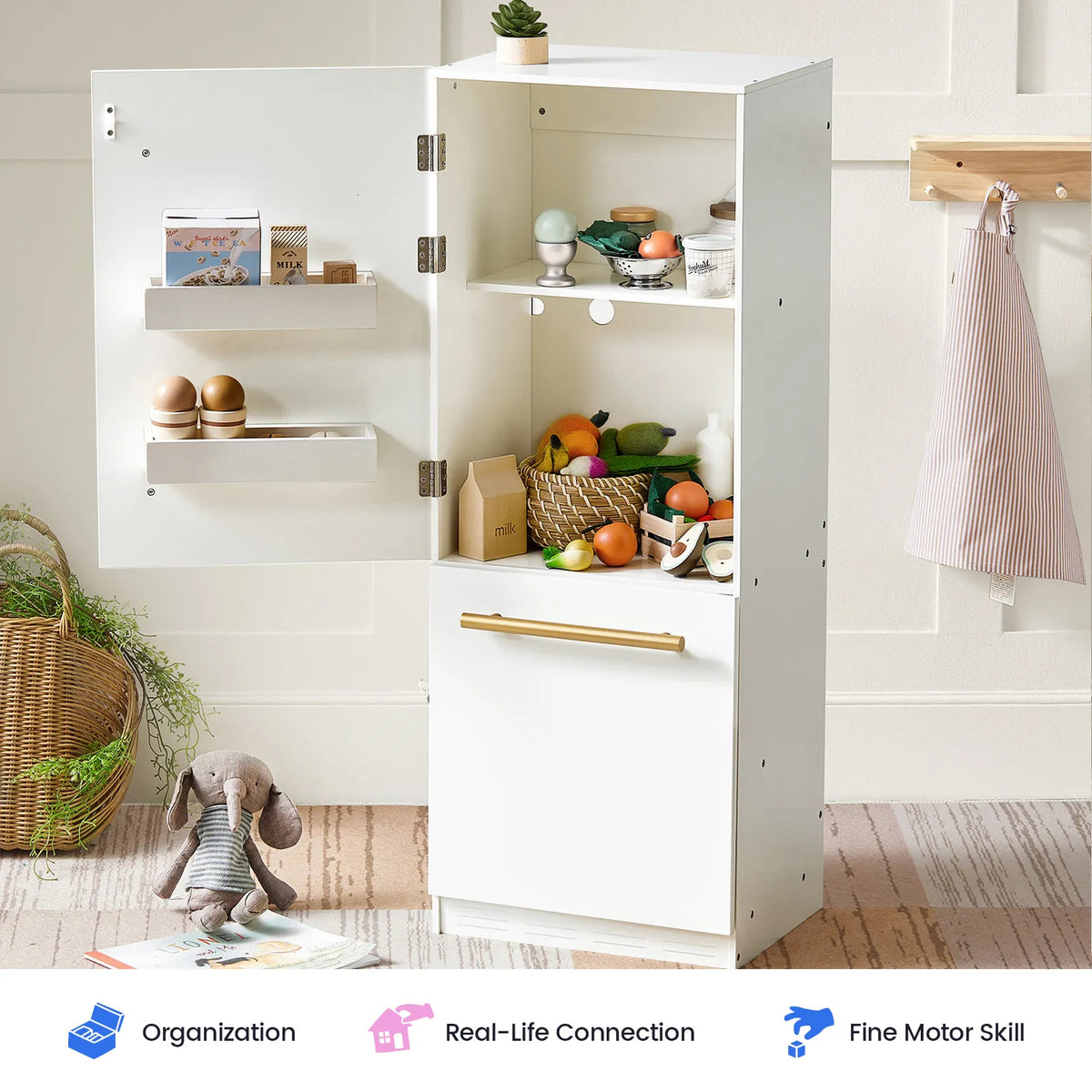
For example, the Tiny Land® Play Kitchen Fridge is a wooden play refrigerator designed for children ages 3 and up. It measures 15 × 13.1 × 40 inches and is made from MDF and eco-friendly plywood.
The design includes four storage tiers and two-tier side-mounted bins, giving children dedicated spaces for organizing pretend food and accessories. The refrigerator door also features three designated magnetic areas with included magnetic decorations.
These features make the refrigerator more than a visual addition to a play kitchen. Children can open the door, organize pretend food, decide what they need, and incorporate the refrigerator into cooking, grocery-store, or family role-play.
For families building a coordinated pretend-play environment, a refrigerator can also be paired with a play kitchen, pretend food, or a market stand to create a larger everyday-play setting.

Is a Wooden Toy Fridge Worth It?
A wooden toy refrigerator can be worth considering if your child already enjoys pretend play and you want to expand the play environment.
But the reason to buy one shouldn't simply be: "It's wooden."
Instead, consider whether the refrigerator gives your child more opportunities to play.
For example:
Play kitchen + refrigerator + pretend food + market stand
can support many different scenarios without requiring a completely new toy for every activity.
The refrigerator can become a place to:
-
Store ingredients
-
Organize groceries
-
Start a cooking story
-
Play restaurant
-
Recreate family routines
-
Create new pretend-play scenarios

5 Easy Ways to Extend Toy Fridge Play
You don't need complicated activities or elaborate instructions.
1. "We're Out of Milk"
Ask: "Can you check the refrigerator? Are we out of milk?"
Your child can check the shelves and decide what needs to happen next.
2. "What Should We Make for Dinner?"
Let your child choose several pretend ingredients.
Then ask: "What can we make with these?"
Move the ingredients from the refrigerator to the play kitchen and let the story develop.
3. "We're Opening a Restaurant"
Give everyone a role.
One person can be the customer, another can cook, and another can organize ingredients.
4. "Let's Go Grocery Shopping"
Create a short pretend shopping list.
Your child can "shop," bring the groceries home, and organize them in the refrigerator.
5. "Who Is Coming for Dinner?"
Invite dolls, stuffed animals, or family members to a pretend meal.
Your child can decide what everyone will eat and prepare the meal using the play kitchen.
The goal isn't to direct every step.
Give children a starting point and let them decide what happens next.

How to Decide If Your Child Actually Needs a Toy Fridge
Still unsure?
Consider these questions:
Does your child already enjoy pretend cooking?
If yes, a refrigerator may expand an existing interest rather than introducing an entirely new type of play.
Does your child like grocery shopping or organizing things?
If yes, food storage and grocery-play scenarios may be especially appealing.
Do you already have a play kitchen?
If yes, a refrigerator can add another part of the pretend kitchen environment.
Do you have enough space?
Measure first. A larger play refrigerator can become a permanent part of a playroom.
Will your child actually use it?
This is the most important question.
A thoughtfully chosen toy that your child regularly uses is more valuable than a toy that simply looks good in a playroom.
So, Do Kids Need a Toy Fridge?
Not necessarily.
But for children who enjoy pretend play, a toy refrigerator can add something a play kitchen alone doesn't provide: a place to store, organize, discover, and incorporate ingredients into a larger story.
Instead of simply pretending: "I'm cooking."
a child can create an entire sequence:
- "We're going to the store."
- "Let's put the groceries away."
- "What should we make?"
- "Dinner is ready!"
That's where a toy fridge can earn its place in the playroom.
And if you're choosing between wooden and plastic, don't make the decision based on material alone.
Consider your child's interests, the available space, construction, age recommendation, safety information, storage, and the types of pretend-play scenarios you want to encourage.
The best toy refrigerator isn't necessarily the one with the most features. It's the one that gives your child more reasons to play, imagine, and create their own stories.
If you're looking for a wooden play refrigerator to add to a pretend kitchen, explore the Tiny Land® Play Kitchen Fridge and compare its size, storage, design, and age recommendation with what your child and play space need.

Frequently Asked Questions
Are toy refrigerators good for kids?
A toy refrigerator can be a useful addition to pretend play, particularly for children who enjoy play kitchens, grocery shopping, cooking, restaurant play, or family role-play. Its value depends on the child's interests and how well it fits into their existing play environment.
What age is a toy refrigerator for?
The appropriate age depends on the specific product. Always follow the manufacturer's recommended age range and safety guidance. For example, Tiny Land's Play Kitchen Fridge is recommended for children ages 3 and up.
Are toy fridges good for toddlers?
Some toy refrigerators are designed for younger children, but parents should always check the specific product's age recommendation, safety information, size, moving parts, and accessories before purchasing.
Is a toy fridge worth buying if my child already has a play kitchen?
It can be. A separate refrigerator can expand pretend play beyond cooking by introducing grocery shopping, food storage, organization, and everyday household routines.
Is a wooden or plastic toy refrigerator better?
Neither material is universally better. Wooden models may appeal to families looking for a substantial, furniture-like addition to a playroom, while plastic models may be preferable for families who prioritize lighter weight, portability, or interactive features.
What should I look for in a toy refrigerator?
Consider the recommended age, stability, construction, size, storage, realistic details, safety information, materials, and whether the refrigerator can support different types of pretend play.
Can a toy refrigerator be used without a play kitchen?
Yes. Children can use a toy refrigerator for grocery-store play, food organization, family role-play, restaurant scenarios, and other imaginative games. Pairing it with a play kitchen can create a more complete pretend-play environment.
What can I put in a toy refrigerator?
Pretend fruits, vegetables, drinks, eggs, milk, play food, menus, and other age-appropriate accessories can become part of refrigerator play. Always choose accessories appropriate for your child's age.
How can parents encourage pretend play without taking over?
Start with a simple prompt rather than a detailed script. Questions such as "What are we making?" or "What do we need from the refrigerator?" can give children a starting point while allowing them to control the story.