




How to Choose a Wooden Dollhouse for Kids
Choosing a dollhouse for your child is about more than picking a style or color. The right dollhouse should fit your available space, match your child's age and play stage, and give them enough room to create their own stories.
For some children, that means a compact house with a few rooms and simple furniture. For others, a larger multi-level dollhouse with more detailed rooms, dolls, and accessories can provide more possibilities for storytelling and pretend play.
If you're comparing a wooden dollhouse, a dollhouse for kids, or a complete dollhouse playset, this guide will help you compare the features that matter most—from size and layout to accessories, assembly, storage, and open-ended play.

What Makes a Good Dollhouse for Kids?
There isn't one dollhouse that is right for every child. A good choice depends on how much space you have, how your child likes to play, and what you want included in the set.
Before choosing a dollhouse, consider these four areas: size and space, layout and accessibility, durability and finish, and accessories and play value.
Size and Available Space
Start by measuring the space where the dollhouse will actually be used.
A dollhouse needs more than enough room for its own footprint. Your child also needs space to stand, sit, reach into rooms, move furniture, and play with dolls around the house.
When comparing sizes, consider:
-
Overall footprint: Check the length and depth of the dollhouse against your available floor or tabletop space.
-
Height: A taller dollhouse can provide multiple levels while using less floor space, but make sure the upper rooms are accessible for your child.
-
Play space: Leave enough room around the dollhouse for children to comfortably reach inside and move accessories.
-
Storage: Think about where furniture, dolls, and smaller accessories will go when playtime is over.
For example, Tiny Land's current dollhouse collection includes different sizes and layouts, so families can compare options based on the space available at home.

Layout and Accessibility
The layout of a dollhouse affects how children interact with it.
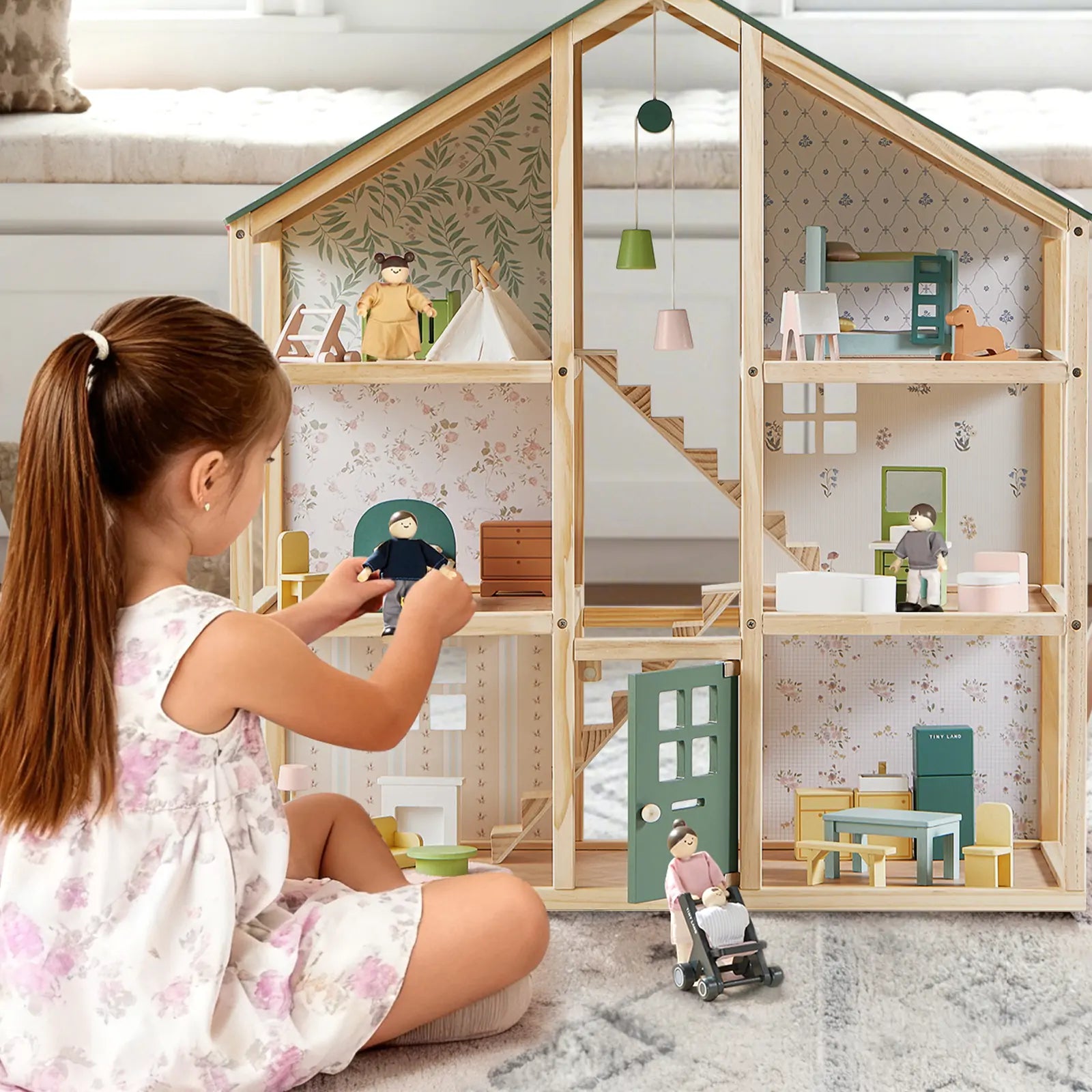
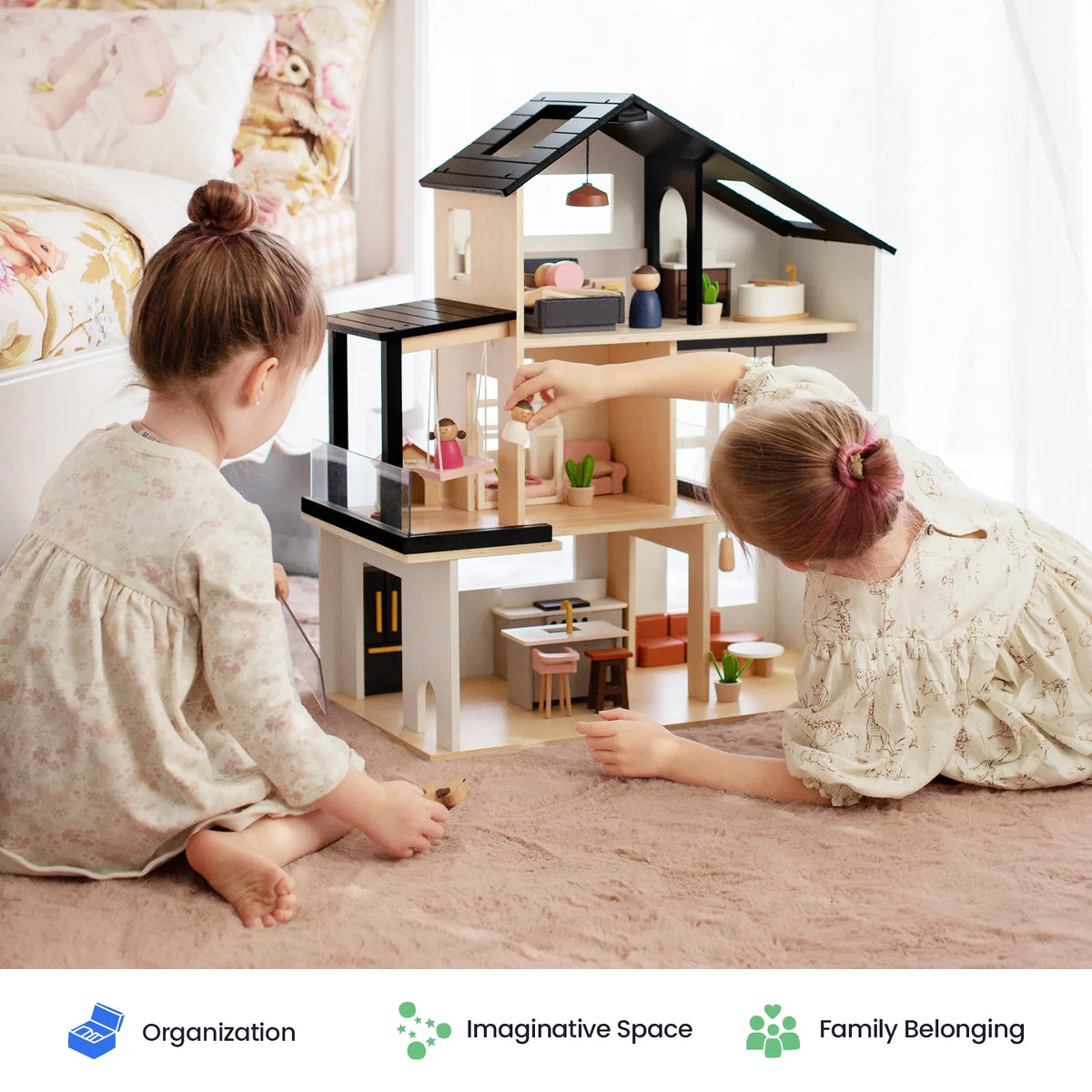
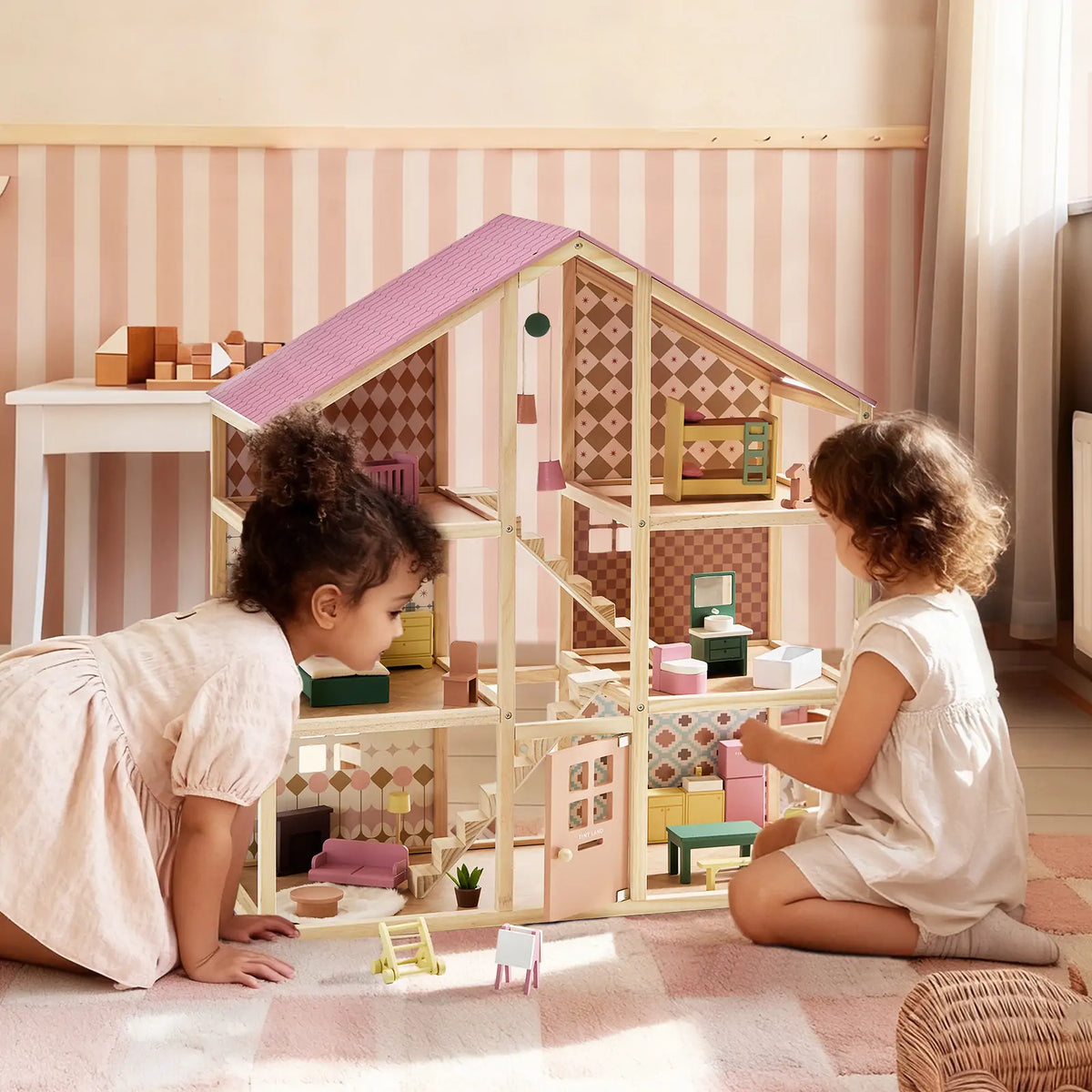
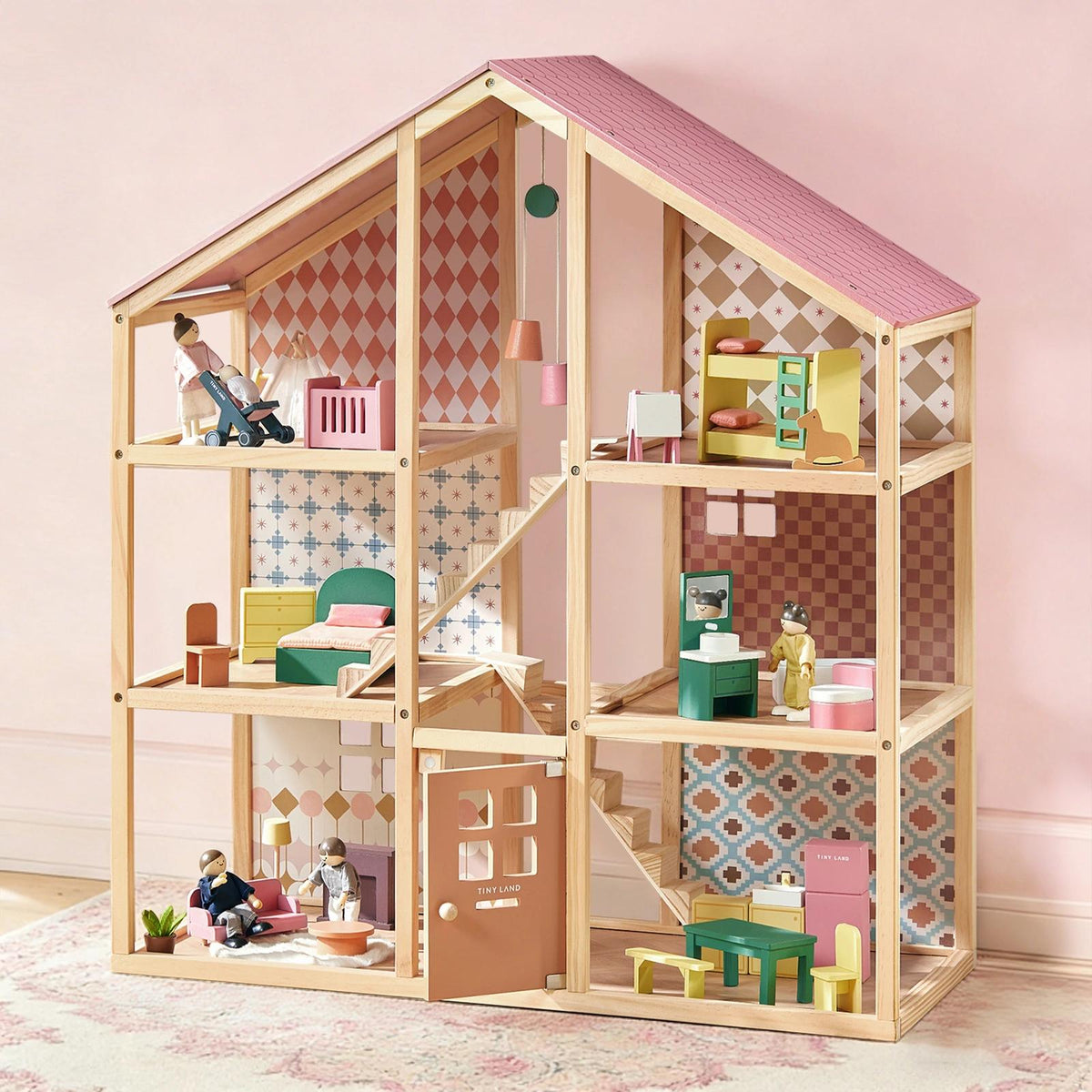
An open design can make it easier to reach rooms, move furniture, and arrange different scenes. Multiple levels and rooms can also give children more places to create separate storylines.
When comparing layouts, ask:
-
Can my child easily reach the rooms?
-
Is there enough space to move the included furniture?
-
Can two children play at the same time?
-
Can I easily see and access the interior?
-
Does the layout leave room for the type of pretend play my child enjoys?
A dollhouse doesn't need to have the most rooms or the largest footprint to be a good choice. The goal is to find a layout that works for your child's play style and your home.

Durability and Finish
A dollhouse is likely to be moved, rearranged, and played with repeatedly, so a well-made one should be durable and crafted for regular use.
When shopping for a wooden dollhouse, look at:
-
The material listed on the current product page, including high-grade wood such as birch or rubberwood
-
The finish and overall construction, including child-safe, water-based, non-toxic finishes and smooth edges with no splinters
-
Whether the product has current safety certifications listed, such as ASTM or EN71
-
The stability of the assembled house, including a solid frame and sturdy assembly methods that help prevent wobbling or collapsing during active play
-
Whether the furniture and accessories are designed for regular play
Quality wooden dollhouses are designed for lasting use and often show careful attention to detail.
Safety information can vary between products, so always check the current product page rather than relying on a general statement about an entire product category.
For example, Tiny Land's current dollhouse product pages list materials, recommended ages, safety certificates, dimensions, assembly requirements, and included accessories for individual products.

Accessories and Play Value
A dollhouse is more than the house itself. Furniture, dolls, and other accessories determine how much a child can do with the space right out of the box.
Before buying, check exactly what is included.
A complete dollhouse playset may include:
-
Beds and bedroom furniture
-
Tables and chairs
-
Kitchen furniture
-
Living room pieces
-
Dolls or family figures
-
Baby accessories
-
Fabric furniture
-
Other decorative pieces
Also consider whether the dollhouse can work with additional accessories later.
You don't necessarily need the largest accessory collection. A smaller selection of flexible pieces can still enhance imaginative play, support creative storytelling, and keep setup fun.

How to Choose a Dollhouse by Age and Play Stage
Age guidance should always start with the manufacturer's current recommended age and safety information.
Beyond the stated age range, children at different stages may use a dollhouse in different ways. Some may focus on moving furniture and naming objects, while others may spend more time creating detailed stories and role-playing everyday routines.
Toddlers and First Pretend Play
For younger children, look first at the manufacturer's recommended age and the size of the individual pieces.
A simple dollhouse can become an introduction to pretend play through familiar actions:
-
Putting a doll to bed
-
Sitting a doll at the table
-
Moving a character between rooms
-
Pretending to cook
-
Creating simple family routines
If you're shopping for a toddler, don't assume that a larger or more detailed dollhouse is automatically better. The important considerations are age suitability, accessibility, and whether the child can comfortably interact with the setup.
For example, several current Tiny Land dollhouse products list a recommended age of 3 years and up, including the Sweetwood Edge, Sweetwood Unicorn, and Sweetwood Evergreen sets.

Preschoolers and Story Building
As children become more comfortable with pretend play, they may begin creating longer stories around their dollhouse.
Instead of simply moving a doll from one room to another, they may create a sequence: Wake up → eat breakfast → get ready → visit a friend → come home → go to bed
At this stage, multiple rooms and movable furniture can provide more opportunities for storytelling.
A child might turn the kitchen into a breakfast scene, the living room into a family gathering, and the bedroom into a bedtime story.
The important factor is not simply the number of rooms. It's whether the layout gives the child enough flexibility to create and change scenes.
Older Children and More Detailed Scenes
Older children may use a dollhouse for increasingly detailed stories.
They may create different characters, rearrange furniture, introduce new settings, or connect the dollhouse with other pretend-play toys.
For these children, consider:
-
More detailed room layouts
-
Flexible furniture
-
Additional dolls or characters
-
Compatible accessories
-
Enough space to create multiple scenes
Rather than choosing based only on age, consider how your child already plays. A child who loves storytelling and imaginative play may benefit from a flexible multi-room house, while another child may prefer decorating and rearranging.

Wooden Dollhouses: Features to Compare
Once you've narrowed down the age and size, compare the actual features of each dollhouse.
Number of Rooms and Levels
More rooms can provide more possibilities for pretend play, but more isn't always better.
Think about how your child will use the rooms.
A multi-level house might include separate spaces for:
-
Living
-
Dining
-
Sleeping
-
Bathing
-
Baby care
-
Children's play
The right layout is the one that gives your child enough space for the type of play they enjoy without becoming difficult to access or store.
Open Access and Visibility
Accessibility matters during everyday play.
Look for a design that allows children to reach the rooms and move furniture without constantly struggling to get their hands inside.
An open-back or accessible layout can also make it easier for parents and siblings to participate.
When comparing dollhouses, don't only look at the front view. Consider how the house works from the child's actual playing position.

Furniture, Dolls, and Included Accessories
Always check the product listing for the exact contents of the set.
Two dollhouses may look similar but include very different combinations of furniture and dolls.
If a set does not include dolls, you may be able to add compatible figures separately. Tiny Land currently sells a separate Wooden Dollhouse Dolls set as well.
Before purchasing, compare:
House only vs. house + furniture vs. complete playset
This makes it easier to compare the actual value of different options.
Assembly, Storage, and Everyday Use
Most larger dollhouses require some adult assembly, so check the assembly information before ordering.
Consider:
-
Whether adult assembly is required
-
Whether tools are provided
-
Estimated assembly time
-
Where the assembled house will stay
-
Where smaller accessories will be stored
For example, the current Sweetwood Pegasus and Sweetwood Evergreen product pages both list adult assembly, provided tools, and an estimated installation time of 45–60 minutes.
Once the dollhouse is assembled, use baskets, trays, or small containers to keep furniture and accessories together. This makes it easier for children to reset the space and start a new story later.

How to Set Up a Dollhouse for Imaginative Play and Open-Ended Play
A dollhouse doesn't need a complicated setup to stay interesting.
The best starting point is often familiar life.
Start with Familiar Family Routines
Begin with scenes your child already understands.
Try:
-
Making breakfast
-
Getting ready for school
-
Taking care of a baby
-
Having dinner
-
Cleaning up
-
Getting ready for bed
-
Visiting a friend
Familiar routines give children an easy starting point for pretend play and can be especially fun to act out.
You can also ask simple questions:
“Who lives here?”
“What are they doing?”
“Where are they going?”
“What happens next?”
These questions leave room for your child to decide what happens instead of giving them a fixed storyline, which supports imaginative play.
Add Furniture and Characters Gradually
You don't need to fill every room immediately.
Start with a few essential pieces and let your child decide where they belong.
For example:
-
Add a bed to the bedroom.
-
Add a table to the dining area.
-
Introduce two or three characters.
-
Let your child create the first story.
-
Add another accessory when they are ready.
This gives children more opportunities to make decisions rather than simply playing with a pre-arranged scene.

Rotate Scenes Instead of Adding More Toys
When a child seems tired of a dollhouse, you don't always need to buy something new.
Try changing the story.
The same house can become:
-
A family home
-
A birthday party
-
A restaurant
-
A hotel
-
A pet home
-
A holiday house
-
A school
-
A place for a family visit
You can also connect a dollhouse with other pretend-play toys. For example, a play kitchen can become a restaurant, while play food becomes the meal and the dollhouse becomes the family's home. Tiny Land has also published ideas for connecting dollhouses with play kitchens, play food, and train sets into one pretend-play world.
For more dollhouse activities, you can also explore Tiny Land's ideas for storytelling, daily routines, decorating, and language-focused dollhouse play.

Tiny Land Dollhouse Options
Tiny Land currently offers several wooden dollhouse configurations, so the best option depends on the space, age guidance, layout, and included pieces you're looking for.
Tiny Land Sweetwood Edge Dollhouse
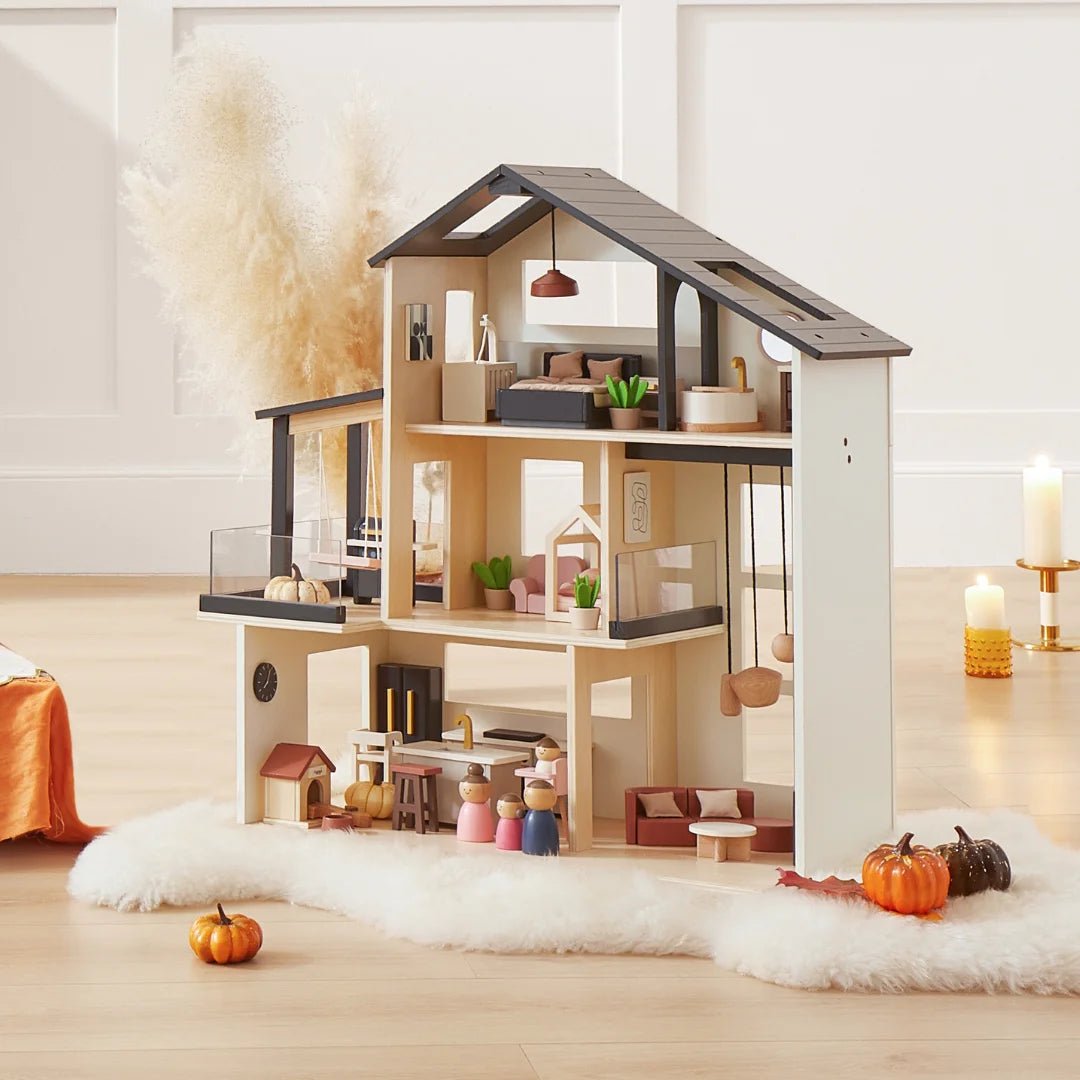
The Sweetwood Edge Dollhouse has a modern design with multiple rooms and an open-back layout. The current product page lists a recommended age of 3+, a product size of approximately 24.4 × 12.2 × 26.8 inches, and a configuration with 53 pieces of furniture and dolls.
This option may be worth considering if you want a modern-looking dollhouse with a detailed setup and included characters and furniture.
Explore the Tiny Land Sweetwood Edge Dollhouse
 Tiny Land Sweetwood Dollhouse Without Dolls
The Sweetwood Dollhouse is a three-level wooden dollhouse with six rooms and furniture included. The current product page lists a recommended age of 3+, dimensions of approximately 31.2 × 28.2 × 12.8 inches, and 31 pieces of furniture. Dolls can be purchased separately.
This configuration can be a useful option for families who already have compatible dolls or want to choose their own characters separately.
Explore the Tiny Land Sweetwood Dollhouse
 Tiny Land Sweetwood Pegasus Dollhouse & Wooden Dollhouse Dolls
The Sweetwood Pegasus set includes a three-level dollhouse with six rooms, a 31-piece wooden furniture set, and a wooden family doll set with a stroller. The current product page lists a recommended age of 3+ and dimensions of approximately 28 × 13 × 31 inches.
This is a complete house-and-dolls configuration for families looking for furniture and characters in one set.
Explore the Tiny Land Sweetwood Unicorn Dollhouse
 Tiny Land Sweetwood Evergreen Dollhouse & Wooden Dollhouse Dolls
The current Sweetwood Evergreen bundle is listed for children ages 3+, with a dollhouse measuring approximately 31.2 × 28.2 × 12.8 inches. The product page lists three stories, six rooms, a wooden doll family set, and 31 pieces of furniture accessories.
This option may suit families looking for a larger multi-room setup with a family-focused configuration.
Explore the Tiny Land Sweetwood Evergreen Dollhouse & Family Set
Explore the Full Tiny Land Dollhouse Collection
Frequently Asked Questions
What age is a dollhouse suitable for?
Age suitability depends on the specific product. Always check the current manufacturer's recommended age and safety information before purchasing.
Several current Tiny Land dollhouse products, including the Sweetwood Edge, Sweetwood Pegasus, and Sweetwood Evergreen, are listed as suitable for children ages 3 and up.
How much space do I need for a dollhouse?
Start with the dollhouse's listed dimensions, then leave additional space around it so your child can comfortably reach the rooms and move furniture and dolls.
If floor space is limited, compare the footprint of different models rather than looking only at the number of rooms.
Are wooden dollhouses better than plastic dollhouses?
Not necessarily. Different materials offer different characteristics.
When comparing a wooden dollhouse with a plastic option, consider:
-
Durability
-
Weight
-
Design
-
Ease of cleaning
-
Room layout
-
Included accessories
-
Recommended age
-
Available space
The best choice depends on what works for your child and home.
What accessories do children need for dollhouse play?
A basic setup can include a few dolls, furniture, and everyday household pieces.
You don't need to fill every room immediately. Start with a few pieces and let your child decide what else the story needs.
Depending on the set, furniture and dolls may already be included. Check the individual product page before purchasing additional accessories.
How can I keep dollhouse play interesting over time?
Change the story rather than constantly adding new toys.
Try rearranging furniture, introducing a new character, creating a family routine, turning the house into a holiday setting, or connecting it with another pretend-play toy.
A dollhouse can become part of a larger pretend-play world alongside a play kitchen, play food, train set, or other toys.

Final Buying Checklist for Choosing the Best Dollhouse
Before choosing a wooden dollhouse for your child, consider:
-
Age guidance: Does the current product information match your child's age?
-
Size: Does the dollhouse fit your available space?
-
Layout: Can your child comfortably reach the rooms?
-
Materials: Does the current product page list high-grade wood and a child-safe finish?
-
Safety: Are the edges smooth, with no splinters, and is ASTM or EN71 information listed where available?
-
Included items: Does the set include furniture, dolls, or other accessories?
-
Assembly: Will an adult need to assemble it, and how much time might that take?
-
Storage: Where will the smaller furniture and accessories go?
-
Play style: Does your child enjoy storytelling, decorating, role-play, or arranging objects?
-
Future play: Can the scenes be rearranged or expanded as your child's interests change?
The best dollhouse isn't necessarily the biggest one, the most detailed one, or the one with the most accessories.
It's the one that fits your home, matches your child's stage of play, and gives them enough freedom to decide what happens next.
A well-chosen dollhouse for kids should be durable enough for regular play and long-term use. Start with the features that matter to your family, choose a setup your child or daughter can comfortably use for creative storytelling, and leave plenty of room for their imagination.