



Children don't simply grow out of play.
They grow into new ways of creating, exploring, and expressing themselves.
A child's creative journey may begin with moving and arranging magnetic pieces. As their interest in drawing grows, they may become more focused on lines, shapes, and pictures, then begin exploring symbols, letters, and early writing. Later, they may want more space to stand, draw freely, and turn their ideas into larger creative projects.
Their interests change. Their hand control develops. Their physical size changes, too.
But these changes don't happen on one fixed timeline. Children develop at different rates, and they may enjoy different types of creative play at the same time.
That's why choosing a kids' easel doesn't have to mean finding one product for one specific age.
A better question is:
What kind of creative experience fits my child right now—and how might that change as they grow?
That's the idea behind Tiny Land's Grow With Kids approach: creating different spaces for children to explore, experiment, draw, and express their ideas as their interests, abilities, and physical needs evolve.

Creativity Changes as Children Grow
Early creativity often begins with simple exploration.
A child may move a magnetic piece across a surface, make their first marks with a crayon, or experiment with what happens when they draw a line or circle.
With experience, those activities can become more intentional.
- Lines can become shapes.
- Shapes can become pictures.
- Pictures can represent people, places, or ideas.
Eventually, children may begin combining drawings, symbols, letters, and words to communicate what they are thinking.
The American Academy of Pediatrics describes scribbling and the progression toward drawing shapes and using writing tools with increasing control as part of early childhood development.
These milestones are reference points rather than strict deadlines, because children develop at different rates.
NAEYC similarly describes emergent writing as a gradual process that can include drawing, scribbling, letter-like forms, and increasingly conventional writing.
An easel, then, doesn't have to be simply a place to "learn to draw."
It can be a space where children explore ideas, practice new skills, and find different ways to express themselves.
As children grow and their interests evolve, a multifunctional easel can offer new ways to create along the way.

1. When Creativity Starts With Moving: Magnetic Exploration
A Creative Option Across Every Tiny Land Easel
Children often explore through touching, moving, arranging, and experimenting with objects before their drawings become more recognizable.
That same instinct can become part of creative play.
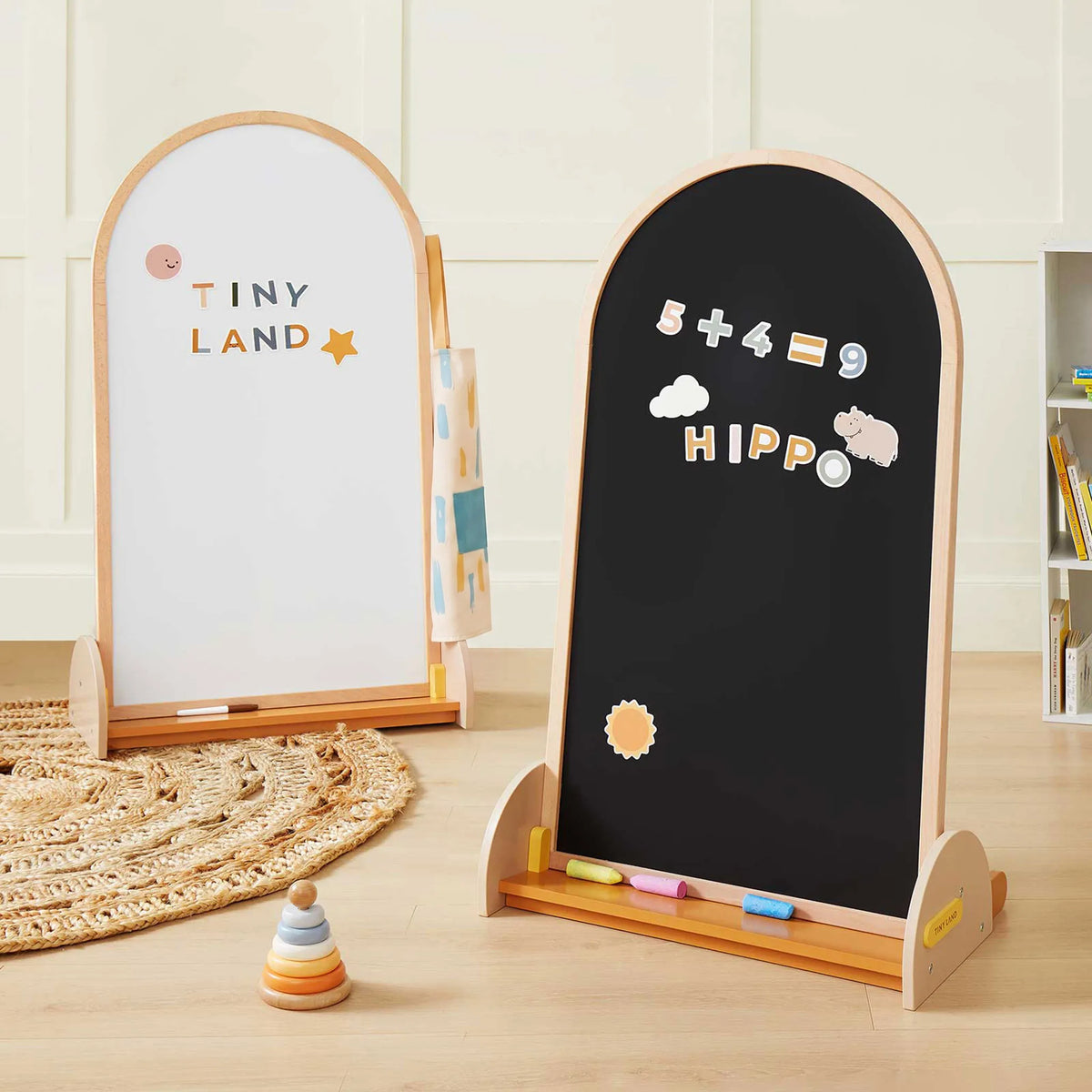
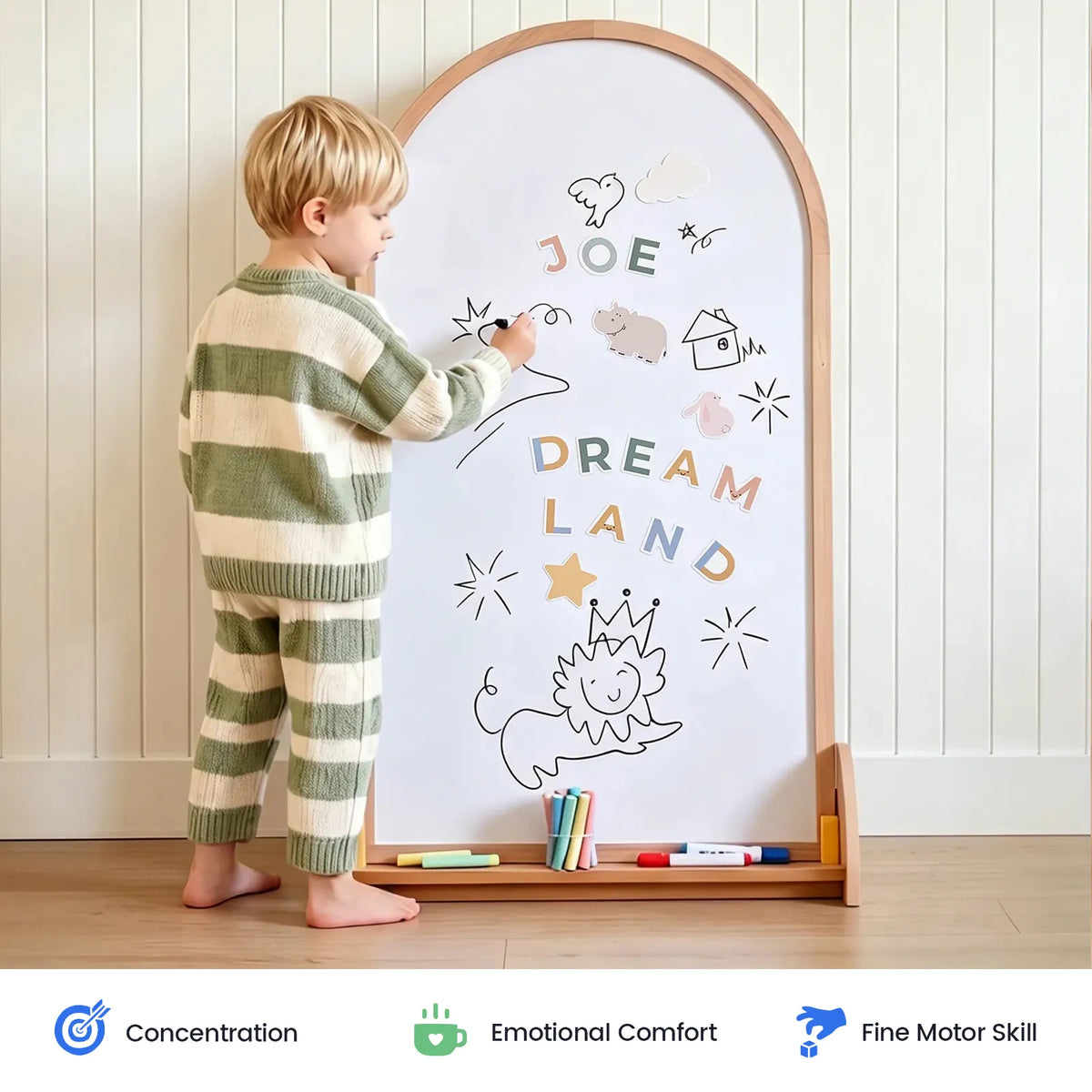
All Tiny Land easels feature magnetic surfaces, giving children another way to create beyond traditional drawing. They can move pieces around, combine different elements, change their arrangements, and build on an idea as it develops.
A child might:
- Match colors or shapes
- Move pieces into different positions
- Combine several pieces to create a scene
- Use pieces as characters or objects
- Rearrange a scene when a new idea comes to mind
- Turn a collection of pieces into a pretend-play story
The process might look something like:
Move → Arrange → Combine → Imagine → Tell
At first, a magnetic piece is simply something to move.
Then, a few pieces can become a house, a character, an animal, or an imaginary scene.
Once children begin deciding what those pieces represent, magnetic play can become a starting point for pretend play, storytelling, and creative expression.
Just as importantly, children can change their minds.
They can move a character, add something new, rebuild a scene, or start again with a completely different idea. There isn't necessarily one correct arrangement, which gives children room to experiment and develop their own ideas.
Handling and repositioning magnetic pieces also gives children opportunities to practice controlled hand movements and coordinate what they see with where they place an object.
Choosing the Right Tiny Land Easel
Because all Tiny Land easels feature magnetic surfaces, parents don't have to choose based on whether their child can explore magnetic play.
Instead, they can choose based on how their child likes to create and play.
The goal isn't to find one "best" easel. It's to find a format that fits the way your child likes to create.

2. When Drawing Becomes More Intentional: Early Writing Prep
A Focused Space for Lines, Drawing, and Early Writing
As children become more interested in drawing, their marks may become increasingly intentional.
They may begin practicing lines and shapes, creating recognizable pictures, and experimenting with symbols, letters, and numbers.
The Tiny Land Tabletop Easel creates a dedicated surface for seated drawing and early writing exploration.
Children can use it to:
- Practice drawing lines and shapes
- Experiment with different kinds of marks
- Color and create pictures
- Draw familiar people, objects, and places
- Explore letters and numbers
- Combine pictures with symbols or words
- Return to a drawing and add new ideas
From Lines and Shapes to Early Writing
Early writing doesn't begin with perfectly formed letters.
Children may first discover that their hand movements create marks on a surface. With growing experience and control, those marks may become more intentional.
- A line can represent a road.
- A circle can represent a person.
- A series of marks can represent an idea.
- As children become interested in written symbols, drawing and early writing may begin to overlap.
NAEYC describes this as part of emergent writing, in which children can move between drawing, scribbling, letter-like forms, and increasingly conventional writing.
The goal isn't to rush children toward conventional handwriting.
Instead, a creative surface provides opportunities to practice controlled mark-making, experiment with lines and shapes, and explore how pictures and symbols can communicate meaning.
This makes the tabletop easel a natural space for focused drawing and early writing prep.
A Creative Routine That Encourages Focus
For children who enjoy seated creative activities, the experience can become:
Sit → Focus → Draw → Practice → Express
And there is no need to "graduate" from a tabletop easel.
Children may continue to prefer seated creative work at different ages, depending on the activity, their interests, and the space available at home.
The important change isn't simply age.
It's that their creative ideas may become more intentional, detailed, and connected to the marks they make.

3. When Children Grow: Creative Play From a New Perspective
Tiny Land Adjustable Standing Easel
Children don't stay the same size. As they grow taller, the creative space around them can change, too.
The Tiny Land Adjustable Standing Easel is designed to adapt to that growth, with an adjustable height that allows families to reposition the creative surface to better suit a child's current height.
The goal isn't to suggest that standing is better than sitting.
It's about giving children another way to create—with a creative space that can change as they grow.
Adjust the Easel as They Grow
A creative surface that works well for a young child may eventually feel too low as they become taller.
An adjustable easel gives families the flexibility to change the height rather than keeping the creative surface at one fixed position.
As children grow, they can continue to use the easel at a height that feels accessible and comfortable for their current size.
That's what makes adjustability meaningful within Grow With Kids:
The child grows → the easel adjusts → the creative space grows with them.
Two Sides, More Ways to Create
The easel's double-sided design gives children two creative surfaces to explore.
Instead of working with only one fixed canvas, children can turn the easel around and continue creating from another side. This gives them more room to explore different ideas, switch between creative activities, and build on what they have already started.
One side might become a space for drawing lines, shapes, or pictures.
Turn the easel around, and the other side becomes a fresh canvas for a new idea.
A child might create a family portrait on one side, then turn the easel around and create an entirely different scene.
Having two surfaces can also make it easier to leave one idea in progress while starting something new.
From Practice to Creative Expression
By this point, children may already have explored lines, shapes, pictures, symbols, and early writing.
Now, creative play can become more open-ended.
They may draw freely, create larger pictures, combine images with words, invent scenes, or simply experiment with whatever idea comes to mind.
The process might look like:
Adjust → Stand → Create → Explore → Express
There isn't one right way to use the space. The activity changes with the child.
And that's the heart of Creative Play.
It's not about completing a particular developmental task.
It's about giving children a flexible space to experiment, make choices, express ideas, and explore different ways to create.

One Child Can Enjoy More Than One Kind of Creative Space
Children's development isn't a straight line. Neither are their creative preferences.
A child may love magnetic storytelling one day and want to practice drawing at the magnetic easel the next.
A preschooler who is beginning to experiment with letters may still spend an afternoon making simple marks.
A child who enjoys creating a large picture while standing may choose to sit when working on a smaller project.
These aren't contradictions.
They're simply different ways of creating.
These aren't fixed age stages. Children may enjoy different easel formats at different times, and more than one may be a good fit for the same child.
So instead of asking: "Which easel is for my child's age?"
consider asking: "What kind of creative experience does my child enjoy right now?"
 Children grow. Their ideas grow. Their creative spaces can grow with them.