





Choosing between a teepee and a play tent for kids is about more than appearance. The shape of a tent, the amount of floor space it needs, and how easily it can be stored all affect how well it fits into your home.
A traditional kids' teepee often becomes a cozy fixture in a bedroom or playroom, while other play tents, such as pop-up and playhouse-style designs, offer different ways to create an indoor fort. Some are designed for quick setup, while others provide a more defined space for pretend play.
So, which is right for your family?
In this guide, we'll compare teepees and tents by their structure, usable space, setup, storage, and everyday use. We'll also look at different home layouts to help you decide which kids' fort makes the most sense for your space.

Teepee vs Play Tent at a Glance
Although a teepee is technically a type of play tent, the two terms often describe different styles when parents are shopping for an indoor fort.
A traditional teepee typically has a cone-shaped or A-frame structure supported by poles and covered with fabric. A play tent is a broader category that includes pop-up tents, playhouse-style tents, and bed tents.
Here's how the main differences compare:
|
Feature |
Traditional Kids Teepee |
Other Kids Play Tents |
|---|---|---|
|
Shape |
Cone-shaped or A-frame structure |
Pop-up, playhouse, bed tent, and other designs |
|
Appearance |
Fabric and supporting poles create a simple, cozy look |
Often more playful, colorful, or themed |
|
Floor footprint |
Requires a defined floor area; sloping walls affect usable interior space |
Varies by design; some are compact, while others need a larger dedicated area |
|
Setup |
Usually involves positioning and assembling supporting poles |
Pop-up styles can open quickly; other designs may require assembly |
|
Storage |
Can be folded or disassembled, depending on the model |
Some pop-up designs fold compactly; larger structures may need more storage room |
|
Everyday use |
Reading, quiet play, pretend camping, and a cozy hideaway |
Role-playing, themed games, hideaways, and room-specific activities |
|
Typical placement |
Bedroom corners, reading nooks, and playrooms |
Playrooms, living rooms, bedrooms, and selected outdoor spaces |
Neither style is automatically better. A teepee may be more suitable if you want a fort that stays in one place, while a pop-up play tent may make more sense if you need something that can be put away after playtime.
The best choice depends on three practical questions: How much room do you have? Will the tent stay assembled? And what does your child actually enjoy doing inside it?

What Is a Kids Teepee?
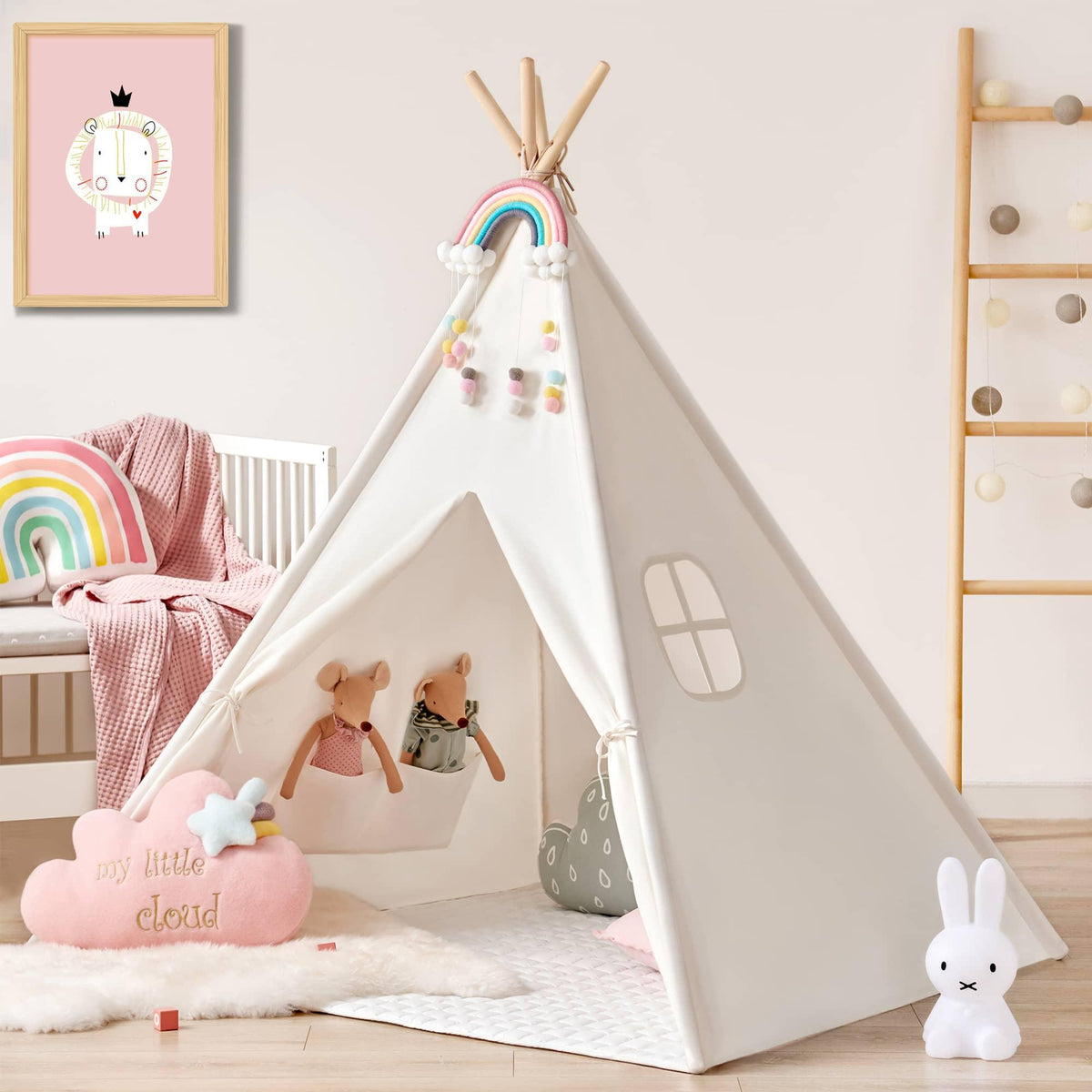
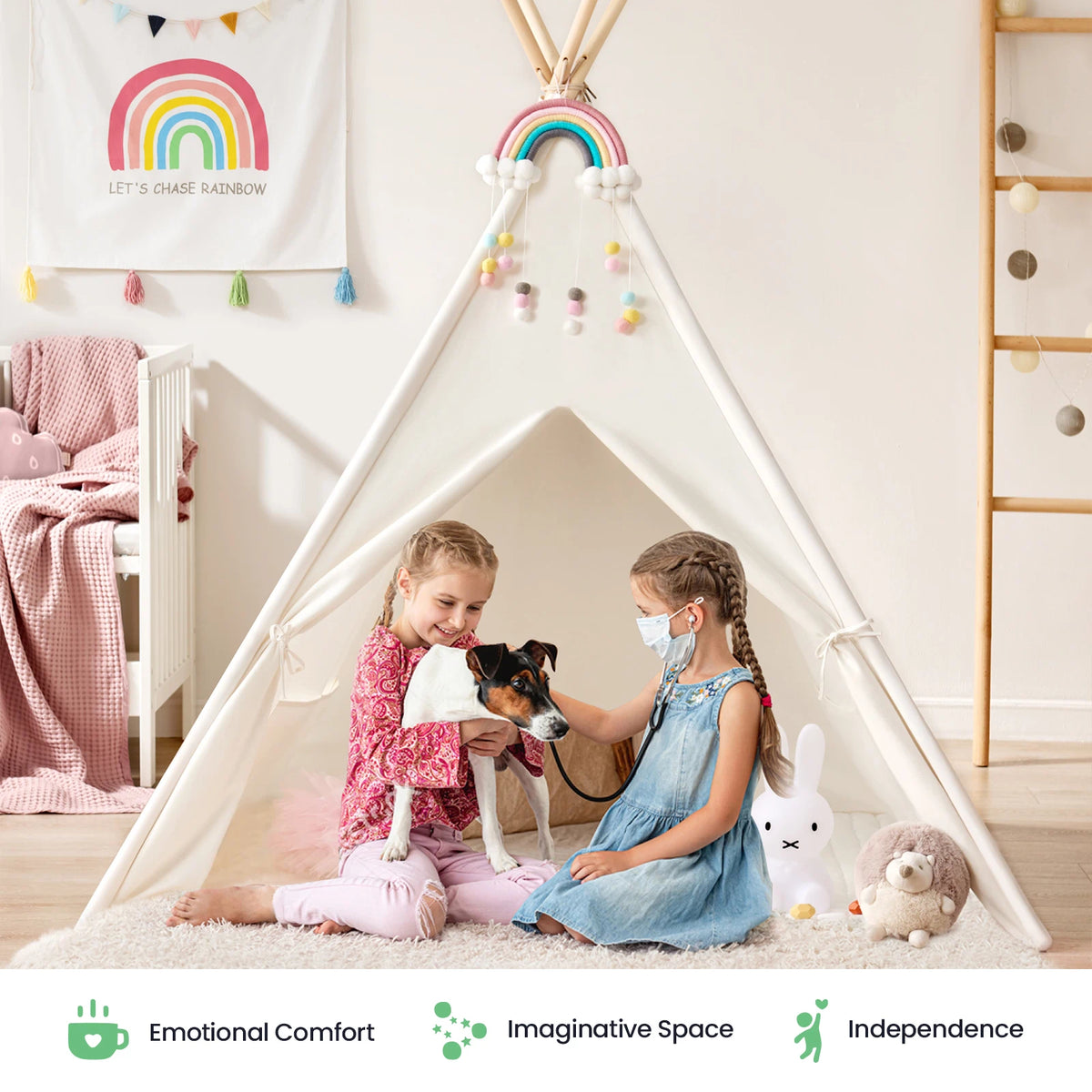
A kids teepee is a fabric play shelter supported by poles, usually arranged in a cone-shaped or A-frame design. Traditional indoor versions often feature a canvas-style appearance, creating a simple and cozy space for children.
Compared with more elaborate playhouse tents, a teepee usually has a less theme-specific design. This makes it a natural option for bedrooms, reading corners, and playrooms where parents want a dedicated play space that also fits the room's overall look.
Classic Canvas Look for Bedrooms and Playrooms
One of the main differences between a traditional teepee and a themed play tent is its appearance.
A canvas teepee for kids typically has a straightforward fabric structure rather than a detailed pretend-play setting. Its simple silhouette can work alongside bedroom furniture, bookshelves, rugs, and other playroom decor.
For parents who prefer a cozy indoor fort without introducing another prominent play theme, this style can be appealing.
A teepee can also serve as a reading nook. A few favorite books, cushions, and soft toys can help create a familiar corner for storytime and quiet activities.
Unlike a play tent designed around a specific pretend-play theme, a traditional teepee can accommodate different activities without changing the overall setup.

Floor Footprint and Usable Sitting Space
When comparing kids' teepee tents, it's important to understand the difference between the tent's footprint and its usable interior space.
The footprint refers to the floor area occupied by the assembled tent. The usable interior space is the area children can comfortably sit or play in.
These two measurements are not the same.
Because a traditional teepee has sloping walls, its interior becomes narrower toward the top. The listed base dimensions may therefore give a larger impression of the available sitting area than children actually have.
Before choosing a model, consider:
-
Base dimensions: How much floor space does the assembled teepee occupy?
-
Interior room: Is there enough space for your child to sit comfortably?
-
Floor accessories: Will a mat or cushions take up additional room?
-
Placement: Can the entrance remain accessible without blocking nearby furniture or walkways?
If you're planning to create a reading nook, think about how much room your child needs to sit with a book rather than focusing only on the tent's overall height.
Some teepees also include features such as windows, storage pockets, or a floor mat. These details can make the space more practical, but the exact features and dimensions should always be checked on the individual product page.

Best Everyday Uses: Reading, Quiet Play, and Pretend Camping
A traditional teepee is particularly suited to activities that benefit from a defined, cozy space rather than a large open play area.
Common uses include:
-
Reading: Create a small reading nook for picture books and storytime.
-
Quiet play: Give children a familiar place to sit with stuffed animals, toys, or favorite books.
-
Pretend camping: Turn an indoor corner into a little campsite for imaginative games.
-
Personal hideaway: Provide a dedicated space for children to enjoy quieter activities.
If you want an indoor fort that can remain set up as part of a bedroom or playroom, a teepee is worth considering.

What Counts as a Play Tent?
Play tent is a broad term that covers several types of children's tents. Unlike the traditional teepee, these designs do not all share the same structure or purpose.
For this comparison, the most relevant categories are pop-up play tents, playhouse-style indoor tents, and bed tents.
Pop-Up Play Tents
A pop-up play tent is designed to open into its intended shape with relatively little assembly. More traditional tent designs often use color-coded poles for a straightforward setup. Many use flexible frames and lightweight fabrics, although the exact materials and folding mechanisms vary by model.
The main appeal is flexibility.
A pop-up play tent may be useful when:
-
You want to create a temporary play area.
-
The tent needs to be moved between rooms.
-
You prefer to store the tent after playtime.
-
Your child enjoys a play space that can be set up for different activities.
Some designs are also intended for occasional outdoor use. However, outdoor suitability depends on the individual product rather than the pop-up structure alone.
Compared with a traditional teepee, a pop-up design may offer a quicker setup process. Its folded storage size, easy assembly, and ease of repacking should still be checked before purchasing.
Tent-style designs inspired by standard tents are often valued for simple, practical shelter-like coverage similar to the straightforward weather protection used on weekend trips, though kids' products still vary by model.

Playhouse-Style Indoor Tents
A playhouse-style tent creates a more recognizable pretend-play environment.
Instead of a simple fabric shelter, it may resemble a small house, shop, restaurant, fire station, or another familiar setting. Some designs include windows, doors, or decorative details that give children a specific environment for imaginative play.
This makes playhouse tents particularly relevant for children who enjoy role-playing and creating stories around their toys, especially with more themed designs that function almost like playhouses.
The trade-off is space. Depending on the structure, a playhouse tent may require a more defined floor area than a compact pop-up design.
It is worth checking the assembled dimensions and considering whether the tent can remain in place without interfering with the rest of the playroom.

Bed Tents and Other Room-Specific Forts
Not every kids' tent is designed to sit directly on the floor.
A bed tent, for example, is designed to fit over a bed and create a more enclosed, room-specific space. Other cozy tent designs may include decorative lighting or features intended for a particular bedroom setup.
These styles serve different purposes from a traditional floor-standing teepee.
The distinction matters when browsing a collection of teepees and tents. A bed tent should be evaluated based on its compatibility with the bed, while an indoor teepee should be evaluated based on its floor footprint and sitting space.
Tiny Land's collection also includes different styles of indoor and outdoor tents, including bed tents and beach-oriented designs. These products should be considered according to their individual intended uses rather than treated as interchangeable indoor forts.

Teepee vs Play Tent: Key Differences That Matter
Once you understand the main tent styles, the decision comes down to how each one works in your everyday space.
Look and How It Fits Your Decor
A traditional canvas teepee usually has a simpler silhouette, with fabric walls and visible supporting poles. It can fit naturally into a bedroom corner or reading nook without requiring the rest of the room to follow a particular theme.
A playhouse-style tent is generally more visually defined. Its shape and decorative details may create a more recognizable play environment, which can be part of the appeal for children who enjoy themed pretend play.
A pop-up play tent can vary considerably in appearance, from a simple fabric hideaway to a colorful play structure.
A teepee may be the better fit if: You want a cozy-looking fort that can remain part of your bedroom or playroom decor.
A play tent may be the better fit if: You want a more playful or themed structure that gives children a specific setting for imaginative games.

Setup Time and Storage
Setup and storage can make a significant difference, particularly if the tent will be used in a shared family space.
A traditional teepee usually requires its supporting poles to be positioned and assembled before the fabric structure takes shape. Once assembled, it can remain in place for everyday use.
A pop-up play tent is often designed to open quickly, making it convenient for temporary play spaces. However, folding it back into its storage shape may require some practice.
Playhouse-style tents vary more widely. Some are relatively straightforward to assemble, while others have more components and may need a dedicated storage area.
Before purchasing, compare:
-
Whether adult assembly is required.
-
Whether the structure can be folded or needs to be disassembled.
-
How much space it takes up when packed away.
-
Whether a carry bag or storage case is included.
If you plan to keep the tent assembled, its everyday footprint matters most. If you need to put it away regularly, the packed dimensions and folding process deserve more attention.

Stability and Everyday Wear
The structure supporting a tent affects how it should be assembled, positioned, and used.
A traditional teepee relies on supporting poles to maintain its shape. The way those poles connect and how the fabric is positioned are important parts of the setup.
Pop-up play tents commonly use flexible frames that hold the fabric in shape. Playhouse-style tents can have different support systems depending on their design.
These structural differences do not mean that one category is automatically more stable than another. Construction, assembly, materials, and the manufacturer's instructions all matter, and a sturdy, durable design helps prevent collapsing during play.
For everyday use:
-
Follow the assembly instructions provided with the product.
-
Place the tent on an appropriate, level surface.
-
Supervise children during play.
-
Do not allow children to climb on or pull the supporting frame.
-
Follow the recommended age guidance and care instructions on the product page.
For safety, note that enclosed tents should allow airflow to support ventilation and help prevent overheating. Many tent-style designs have mesh panels, and standard tents often rely on sealed units and mesh to manage air quality in warmer conditions.
Look for ASTM-compliant tents for added safety assurance, as many have been tested, use non-toxic materials, and meet that standard. Avoid tents with small pieces that could be choking hazards.
When comparing tents, look at the actual construction and durability rather than relying on the general category name. Some synthetic fabrics may use flame retardants, so check the listed materials.

Indoor vs Outdoor Suitability
Indoor canvas teepees and outdoor play tents should not be treated as interchangeable.
A cotton canvas teepee is often selected for its fabric appearance and suitability as an indoor reading nook or playroom fort. Some individual models may also be marketed for outdoor play, but this must be confirmed on the product page. Some outdoor-ready kids tents use waterproof fabric and UPF 30 coating, though single-skin canvas teepees may struggle in heavy rain without a liner.
Pop-up tents may use lightweight synthetic fabrics, including polyester, and some are designed for short outdoor activities. Certain beach or outdoor tents may also include features intended for their specific environment, making some options more suitable for indoor outdoor use.
However, not every pop-up tent offers weather protection or sun protection.
Before using a tent outdoors, check:
-
Whether the manufacturer identifies it as suitable for outdoor use and whether the product specifically lists features such as waterproof fabric or UPF 30 coating.
-
Whether it has any stated weather or sun-protection limitations.
-
Whether it can be secured to the ground for stability.
-
Whether the structure is intended for occasional outdoor play or another specific use.
A bedroom teepee should not automatically be treated as a camping tent, and an indoor play tent should not be assumed to provide UV protection.

Who Usually Enjoys It Longer?
How long a child enjoys a particular tent depends more on their interests and the tent's usable space than on the category alone.
Children who enjoy reading, quiet activities, and pretend camping may appreciate the simplicity of a traditional teepee.
Children who enjoy role-playing may prefer a playhouse-style tent that gives them a recognizable setting for their games.
A pop-up play tent may appeal to children who enjoy having a flexible hideaway that can be moved or stored between activities.
Age recommendations also vary by product. A tent that offers enough room for a younger child may feel less comfortable as the child grows, so check both the recommended age range and the available interior dimensions.

Which Kids Fort Fits Your Space?
The most useful way to choose between a teepee and a play tent is to start with the room where it will be used.
The same tent can be a great fit in one home and inconvenient in another. Consider these five common setups before deciding.
Small Bedroom Corner or Reading Nook
Suggested choice: Traditional canvas teepee.
If you have an unused corner in your child's bedroom, a traditional teepee can create a dedicated reading nook without introducing a complicated play theme.
Its simple structure and fabric appearance can complement existing bedroom furniture, bookshelves, and soft furnishings.
A teepee with a floor mat can also help define the sitting area, making it easier to create a cozy spot for books and quiet activities.
The main consideration is the actual footprint. Measure the available corner and remember that the sloping walls reduce usable interior space.
Choose this style when you want a fort that can stay assembled and become part of the room's everyday layout.
Shared Playroom With Siblings
Suggested choice: A larger playhouse-style tent or a teepee with sufficient interior space.
In a shared playroom, the number of children using the fort matters as much as the tent's overall appearance.
If the tent is mainly intended as a reading corner for one child at a time, a traditional teepee may work well.
If siblings enjoy playing together and creating pretend scenarios, a playhouse-style tent may offer a more suitable environment, provided the assembled dimensions allow enough room. For example, the Tiny Land Large Kids Tent fits at least two kids comfortably, and details like front flaps or a roll-up door can also make shared play easier.
Before choosing, consider:
-
How many children are likely to use the tent at once.
-
Whether they need space to sit, move, or play with toys.
-
Whether the entrance is easy to access.
-
How much room remains for other playroom activities.
Do not rely on the exterior dimensions alone. Check the actual usable interior space and the manufacturer's recommended use.

Living Room That Needs Easy Pack-Away
Suggested choice: Pop-up play tent or a foldable teepee.
A living room often needs to serve several purposes throughout the day. A permanent play structure may not be practical if the area is also used for family activities or entertaining.
A pop-up play tent may be a convenient choice when quick setup and pack-away are priorities.
A foldable teepee is another option if you prefer its appearance but do not want it to occupy the living room permanently.
The deciding factor is how often you expect to store it. If the tent needs to be put away every evening, look closely at the folding process and packed dimensions.

Apartment or Home With Limited Floor Space
Suggested choice: A compact, foldable play tent or a small-footprint teepee with a dedicated corner.
In an apartment or a home with limited floor space, the difference between assembled size and storage size becomes especially important.
A teepee can work in a small home if there is a suitable corner where it can remain set up. However, the supporting poles and sloping walls still require a clear floor area.
If you do not have a permanent corner available, a foldable or pop-up play tent may be more practical.
Think about both sides of the space equation:
-
When open: Does the tent leave enough room to move around?
-
When stored: Can it fit into a closet, storage area, or another convenient location?
If the tent needs to be packed away frequently, prioritize its storage design over decorative features.

Occasional Outdoor or Travel Use
Suggested choice: A tent specifically designed for outdoor use.
If your main purpose is backyard play, a beach visit, or family travel, look beyond traditional indoor teepees.
Some lightweight pop-up or outdoor tents are designed to be transported and set up for occasional outdoor activities. Depending on the model, they may offer features suited to a particular environment.
However, not every play tent is appropriate for outdoor use, and a cotton indoor teepee should not automatically be treated as an outdoor shelter.
Check the product's intended use, packed dimensions, setup instructions, and any stated weather or sun-protection limitations.
For outdoor activities, suitability for the environment should take priority over whether the tent looks like a traditional indoor fort.

How to Choose Without Overbuying
After comparing the different styles, four practical decisions can help you narrow down the options without purchasing more features or space than you need.
Measure the Footprint First
Start with the actual area available in your home.
For a teepee, check the base dimensions and remember that the sloping walls affect how much interior room is available for sitting.
For a playhouse or pop-up tent, check the full assembled dimensions and consider whether the entrance and surrounding space will remain accessible.
If storage is important, compare the packed dimensions as well.
Match the Fort to How Your Child Actually Plays
Choose the structure based on activities your child already enjoys, and on the kind of imagination or indoor adventures they naturally gravitate toward.
-
Reading and quiet play: Consider a traditional teepee.
-
Pretend houses and role-playing: Consider a playhouse-style tent.
-
Flexible indoor play: Consider a pop-up play tent.
-
A cozy space around a bed: Consider a bed tent as a fun space to read, relax, or wind down.
This is more useful than choosing a tent simply because it has more decorative details or accessories.
Decide If It Stays Up or Packs Away
Be realistic about where the tent will live.
If it will stay in a bedroom corner, a teepee's appearance and everyday footprint may be the most important factors.
If it needs to be stored after every play session, focus on how easily it folds, how much space it takes up when packed, and whether storage accessories are included.
Plan for a Mat, Lighting, and Cleanup
A mat can make a floor-standing teepee more comfortable for sitting and reading, particularly on hard flooring.
String lights may help create a cozy reading nook, while storage pockets can keep small items nearby. Some tents can also be personalized with a child’s name or initials for a more unique setup.
However, additional features should match the way the tent will actually be used. Check the individual product listing to confirm what is included rather than assuming all teepees or play tents come with the same accessories.
For more general considerations beyond this comparison, you can also explore our kids play tent buying guide.

Tiny Land Options to Explore
If you're still deciding which style suits your home, browsing different types of tents side by side can help clarify the choice.
The Tiny Land Teepee & Play Tents collection includes different styles for different spaces and activities, from traditional teepees and indoor play tents to bed tents and selected outdoor or beach-oriented designs.
Rather than treating every style as interchangeable, start with the space you want to create: a reading nook, an indoor play area, a bedroom hideaway, or a portable outdoor setup.
Teepee Tent for Kids With Mat: A Reading Nook for Everyday Use
For families looking for a traditional teepee-style fort, the Tiny Land® Teepee Tent for Kids with Mat is an option to consider.
Designed around the classic indoor teepee setup, it offers several practical details for a dedicated play or reading corner:
-
Included floor mat: Provides a defined area for sitting and quiet activities.
-
Storage pockets: Offer a place to keep small items nearby.
-
Window: Adds a window feature to the tent design.
-
Carry bag: Provides a storage option when the tent is taken down.
These features make it worth exploring if you want a traditional teepee with an included mat rather than a different style of pop-up or playhouse tent, and some premium options on the market use materials such as FSC-certified beechwood and natural canvas as a useful benchmark for build quality and everyday life.
As with any kids' tent, check the product page for the latest dimensions, materials, included components, recommended age guidance, and assembly instructions before purchasing. Also, purchase from a reputable vendor and follow the product instructions closely.
You can view the Teepee Tent for Kids with Mat to see whether its design fits your intended space.

FAQ
1. Is a teepee better than a play tent for kids?
Neither is better for every family. A traditional teepee is a good option if you want a cozy-looking fort for a bedroom corner, reading nook, or quiet play. Other play tents, such as pop-up and playhouse-style designs, may be more suitable if you prioritize quick setup, flexible storage, or themed pretend play. The right choice depends on your available space and how your child plans to use it.
2. What is the difference between a kids teepee and a pop-up play tent?
A kids' teepee typically uses supporting poles arranged in a cone-shaped or A-frame structure, with fabric covering the frame. A pop-up play tent generally uses a flexible frame designed to open into shape. Teepees are often chosen for a more permanent bedroom or playroom setup, while pop-up tents are commonly considered for temporary play spaces and easier pack-away.
3. Are kids teepees good for small rooms?
A kids' teepee can work well in a small room if you have a suitable corner for it. However, the assembled footprint and interior sitting space should both be considered. Because teepee walls slope inward, the usable interior area is smaller than the base footprint might suggest. Measure the available floor space before choosing a model.
4. Can I use a cotton teepee outdoors?
It depends on the individual product. Some teepees may be marketed for both indoor and outdoor play, while others are intended primarily for indoor use. Check the manufacturer's stated use and care instructions before taking a cotton teepee outside. Do not assume that an indoor canvas teepee is suitable for all weather conditions or extended outdoor exposure.
5. What age are teepees and play tents for?
Age recommendations vary by tent design and manufacturer. Some products are designed for toddlers, while others have a higher recommended starting age. Always check the age guidance on the individual product page, along with the available interior dimensions and assembly instructions. The child's size and intended activities should also be considered.
6. Do I need a floor mat inside a teepee?
A floor mat is not essential for every teepee, but it can make the space more comfortable for sitting, reading, and quiet play. If a mat is not included, check the interior dimensions before purchasing one separately. Make sure it fits the tent without interfering with the entrance or structure.
7. Teepee or play tent—which is easier to store?
Storage depends on the individual design. Some pop-up play tents fold into compact shapes, while traditional teepees may need to be disassembled or folded before storage. Some teepees also include carry bags. Compare the packed dimensions, folding instructions, and included storage accessories rather than assuming one category is always easier to store.

Final Recommendation: Choose the Kids Fort That Fits Your Space
When comparing a teepee vs. a play tent, there is no single style that works best for every home.
The decision comes down to whether you want a fort that stays set up, how much floor space you can dedicate to it, and how easily it needs to be stored.
-
Choose a traditional teepee if you want a cozy, simple-looking fort for a bedroom corner, reading nook, or everyday quiet play.
-
Choose a pop-up play tent if quick setup, flexible storage, and temporary play spaces are your priorities.
-
Choose a playhouse-style tent if your child enjoys themed environments and imaginative role-playing.
-
Choose a bed tent or outdoor tent when you have a more specific room setup or outdoor activity in mind, and make sure the product is designed for that use.
The best kids' fort is not necessarily the biggest or most elaborate one. It is the style that fits your home and the way your child likes to play.

Ready to compare different styles?
Browse Tiny Land's Kids Teepees and Play Tents to explore options for reading nooks, indoor forts, bedroom spaces, and more.
Looking for a traditional teepee with an included mat? Explore the Tiny Land Teepee Tent for Kids with Mat.